
Being Mortal: Medicine and What Matters in the End — By Atul Gawande

Fact #1: Lacking some significant medical breakthroughs, if you’re reading this sometime in 2024, you’re probably going to die within a single-digit number of decades.

Fact #2: The entire medical profession has been incredibly well-trained and well-equipped to keep us from dying.

Combining Fact #1 with Fact #2 leads to a bit of conflict and unease in our society.

But first, let’s rewind the clock a generation or two and look at how we got here.

Prior to the 1930s, families provided the care and support for their elderly family members until their death. If you didn’t have a family to support you, then you had a couple of different options.

Option #1 is the best choice: have bags and bags of money lying around to hire help in old age. The folks fitting that profile were predictably well taken care of. Option #2 was considerably more bleak. This involved being placed in an asylum/poorhouse with a whole bunch of other people with no family to care for them. By all accounts, those were some dismal and dehumanizing places to live.

In a nifty confluence of events, at roughly the same time that Social Security rolled out and started providing financial support to those seniors who had no family nor funds to support them in their old age, the medical advances developed during World War II started to lap up on our shores. Old age quickly moved from being merely another stage of life with a predictably precipitous end and came to be viewed more as a medical problem that could be fixed with our newfound technologies like antibiotics and surgical techniques. The solution for old age was pretty obvious: put old people in hospitals.

That approach worked for a couple of years, but then hospitals started to realize that their beds were filling up with people who weren’t dying nor getting well. This led to a couple different efforts to addressed the problem. Effort #1 was that in the 1950s and into the 1960s, the federal government dumped billions of dollars into the construction of new hospitals across the nation. But as it became clear that hospitals couldn’t keep up with demand for their beds, in the late ’50s and into the early ’60s, a new form of care came into being: the nursing home.

As the name implies, nursing homes were designed to provide care to the sick and elderly. The structure was built around the idea of the patient being, well, a patient. The operating and business practices of nursing homes were designed to promote the efficiency of the facility and not necessarily caring so much about the needs and desires of the patients.

Enter a new idea: the assisted living facility. Assisted living, at its best, tries to hand the autonomy of life decisions back to the resident in terms of what time they shower, what time they wake up, what time they go to bed, what they eat, when they eat, who they have over as visitors and/or lovers, etc. All this just happens to occur where skilled nursing is available just down the hall.

Preserving that sense of self and independence is, in my mind, the guiding star of what medicine should be aiming to provide and what I should be asking of my health care providers now that I am, ahem… old.

With medical science now able to prolong life far beyond what had been dreamt of in years past, the question now becomes one of when scientific and technological prowess need to recognize human mortality. As Gawande points out, he was trained to fix problems. If you have cancer, do some surgery. Do some chemo. Do some radiation. And if those remedies cause some cascading series of issues and traumas, those are to be dealt with those as they come. The medical profession has gotten so good at addressing individual medical problems that human existence can get whittled down to the point where people are kept alive without actually living.

Having arrived at the ripe age of nearly 51 years old now, my takeaway from this book is that we all need to be thinking about what it is we want from our medical care. What is it that we are willing to give up to get to a certain outcome? If what gives life meaning is stripped away and a person is left as a breathing stump of a human in a bed, have we really made any progress?

That’s a trick question.

Gawande’s point is that the question above doesn’t have a single answer. The answer varies from one person to another to another. And the range of answers varies significantly. For some who are facing rounds of chemo and surgery, they just want to make it out of that process with the ability to watch football on TV and eat ice cream. That’s enough for them. For others, that outcome sounds horrific and not worth the trade.

Those conversations, as awkward as they might be, are the path forward that allows patients, families, caregivers, and doctors the ability to determine when to press ahead with treatments and when to say “What do you want out of your remaining days, however many they might be?”.
Who Gets Believed? When the Truth is Not Enough — By Dina Nayeri

When applying for political asylum, should you wail, emote, and be purely raw with your emotions as you recount the horrors that led you to apply for asylum in the first place? Or should you take the stoic approach, reciting dates, facts, names of torturers, names of rapists, etc., with as little emotional overlay as possible?

It’s a trick question.

It all depends on the asylum intake officer on the other side of the desk. Some officers will connect with the emotional appeal, others will shrug it off as an act that is being overplayed. Conversely, some officers will interpret a bullet-point listing of transgressions as lacking in human emotion. If it were really that bad, wouldn’t there be more of an outward expression of trauma? And vice versa.

If — lawd forbid — you are ever in need of pain medications to get through your day, at a certain point, you’re going to have to convince a doctor that you’re truly in pain and not just seeking pills. After speaking with a number of doctors and pain specialists, Nayeri settles on this as the ideal approach for those seeking pain relief: I know I’ve had pain medications before, doc — some worked better than others — but I don’t care what it is you give me, I just want to not deal with this pain. This approach sidesteps the issues of appearing to be hooked on a particular medication (Just give me the Oxy, Doc!) and it hands the control of the “what” and the “how” of the pain treatment over to the professional. Not too demanding, not too specific. But a patient in need of pain management also walks a line akin to applying for asylum in that the decision comes down to the particular doctor in charge of making that decision on that particular day. Okay, good to know.

I went into this book thinking that I was going to be led to some deep insight that would allow me to crack the cult of Trump and break down the conspiratorial mindset. This was a good read but, unfortunately, Nayeri didn’t get me there. It’s not her fault as it’s a big ask of an author to intuit the wants of this particular reader before she hit the “send” button to her publisher.

As it turns out, the author’s brother-in-law had lifelong struggles with mental health issues. About 2/3rds of the way through the book, it becomes clear that while the author does a good job of pulling together multiple threads to weave together a book about belief and believing (asylum seekers, pain patients, religion, etc.), it’s really a reckoning of her relationship with her husband’s brother.

My takeaway? Err on the side of “innocent until proven guilty”, especially when it comes to issues of the powerless beseeching the powerful to believe their stories.

If you wanna check this out for yourself, go track down a copy here: https://worldcat.org/en/title/1371040417

Parenting, Jesus and me

Holy crap. In less than two pages, Simon Rich summed up everything that anyone might ever want to know about parenting. Here’s the link: https://www.newyorker.com/magazine/2023/01/02/and-the-lord-said-youve-got-a-time-out-mister

But, just in case link rot kicks in and the link above doesn’t you where you need to go, here’s the full text of the article:

And so the Lord created two humans in His image, called Adam and Eve. And He put them in the Garden of Eden and provided them with everything that they could want. And all He asked in return was that they not eat from the Tree of Knowledge. But, lo, it came to pass that they did eat from this tree. And when the Lord saw that they had disobeyed Him, He was filled with wrath. And so He said to Eve, “Because you have done this, I will make your labor pains severe, and you will suffer greatly during childbirth.” And to Adam He said, “From this day forth, you will work by the sweat of your brow in the fields, and indeed you shall die there, for you are made of dust, and to dust you shall return.” And He banished Adam and Eve and brought forth His Angel to guard the Garden with a flaming, whirring sword for all eternity.

And when Adam and Eve were out of earshot, the Lord turned to His Angel and said, “Was that too harsh?”

And the Angel stared back at Him and said, “Uh, yeah, probably. They ate one piece of fruit.”

And the Lord groaned and said, “Why didn’t you stop me?”

And the Angel said, “We’re supposed to be a united front. If we contradict each other, it’ll just make them confused.” And she shook her head and said, “What was with that ‘dust’ thing?”

And the Lord sighed and said, “I don’t know. I knew it was crazy even while I was saying it, but I couldn’t stop myself. It was just, like, out of nowhere I heard my dad’s voice coming out of my mouth.”

And the Angel said, “Well, I guess we should go talk to them.”

And the Lord said, “What do you mean?”

And the Angel said, “You know, to tell them we changed our mind about the punishment.”

And the Lord said, “No, we’ve got to follow through. Otherwise, they’ll never take anything we say seriously again!” And He handed her the sword and set it on fire and told her to start whirring it.

And the Angel said, “I really don’t think we’re going about this right.”

And the Lord said, “Just let me handle the discipline, O.K.? I know what I’m doing.”

And so the Lord stuck to the banishment thing. But, despite the harsh punishment, the humans continued to sin. And one day the Angel showed the Lord a note from school, and He was, like, “Fuck, this is some major shit.”

And the Angel said, “Yeah, they’re starting to have real behavioral problems. We should talk to a psychologist and get some advice on what to do.”

And the Lord said, “There’s only one thing we can do: bring the hammer down.”

And the Angel said, “What? Why?”

And the Lord said, “Because we set a precedent with that fucking fruit thing! If we don’t punish them at least that much for this new stuff, they’re going to think that sodomy and murder aren’t as bad as, like, sharing a bite of an apple.”

And the Angel said, “I’ve actually been reading a lot about this lately, and most experts agree that punishments are counterproductive.”

And the Lord said, “So, what, we’re just supposed to let them do whatever they want and become drug addicts?”

And the Angel rolled her eyes and said, “I’m obviously not saying that I want them to become drug addicts.” And then she added, softly, “This is why we should’ve signed up for that class.”

And the Lord said, “That class was bullshit!”

And the Angel said, “How would you know? You refused to even read the description on the Web site.”

And the Lord said, “It was held in the basement of a toy store! It was obviously just a scam to sell us toys!”

And that was how the conversation ended, without any resolution about the whole discipline thing.

And so the Lord punished the humans more and more, with floods and plagues and entire centuries without any television, and He kept giving them new rules, some of which made sense, but some of which were arbitrary, like “Don’t mix milk and meat,” which was something He’d just blurted out one morning when He was half asleep but now felt obliged to stick to. And it got to the point where He could barely even keep track of the rules that He had made, or what the penalties were for breaking them. And so the humans were punished inconsistently, in ways that had more to do with His frustration level than with any kind of actual philosophy or game plan. Like, sometimes the humans would have punishments heaped upon them for basically no reason, and sometimes they’d do something truly messed up and get no punishment at all, or even be rewarded with political office.

And the Angel would say, “What happened to being consistent?”

And the Lord would tell her some bullshit about how it was a Test, but really it was just that He was overwhelmed and exhausted and also privately kind of stressed out about money.

And so it came to pass that there was basically zero continuity. And one day, in desperation, the Lord suggested that they pick the ten main rules and engrave them on a pair of stone tablets.

And the Angel said, “A, they’re never going to follow that, and, B, it’s completely unenforceable. Like, the only way to police it would be to watch them around the clock, which would be more of a punishment for us than for them.”

And the Lord broke down and admitted that the Angel was right, and that the tablet thing was crazy, and that He’d only suggested it because He was so beat down and broken and stressed out about money that He didn’t know what the fuck to do anymore about anything.

And the Angel said, “What is going on with you? You can tell me.”

And the Lord took a deep breath and confessed His secret fear: “I feel like the humans are becoming bad people, and it’s all because of me.”

And the Angel took His hand and said, “That isn’t true.”

And the Lord looked hopeful and said, “So you think the humans are turning out all right?”

And the Angel said, “No. They obviously have some real issues. But I don’t think it’s all because of you.”

And the Lord said, “Everything’s all because of me. I’m omnipotent.”

And the Angel said, “I think maybe, when it comes to creating humans, no one is. Sure, you can guide them a little here and there, and, obviously, it’s possible to really fuck them up, like, that’s been proven with those Romanian-orphanage studies. But in general you can’t control what kind of people they become. No matter what you do, they just end up turning into . . . themselves.”

And, as her point was sinking in, the Lord looked down and saw that the humans had started a new war. And He was going to do what He normally did (punish all involved, whether they’d started it or not), but instead He turned to the Angel and said, “Maybe we should go out tonight?”

And the Angel said, “What about the flaming sword?” Because she’d been whirring it around this whole time.

And the Lord was, like, “I’m sorry I made you do that. You can put it down. That was just me being nuts.”

And so they dressed up and went out for the first time in eternity. And they ordered drinks and appetizers and the whole thing. And they talked about fun subjects that they couldn’t discuss when the humans were around, like whether or not Heaven was real, and how the secret numerical code in the Bible really worked. And they had so much fun that it felt like they were back In The Beginning, before they had humans, or even any animals, and it was just the two of them floating around among the sun and moon and stars.

And it came to pass that spending some time away from the humans made them feel better about them. And the Lord quoted some of the cute things He’d overheard them saying lately, like “I have a plan for my future” and “Here is the forecast for tomorrow’s weather.” And the Angel showed the Lord photos of some of the cute crap that the humans had made recently, like forts and towers and cities, and even though the Lord knew that it was going to be a pain in the ass to clean it all up, and that the humans would probably cry when He knocked it all down, He had to admit that it was adorable.

And they stayed out so late that they lost track of time, and their babysitter, Satan, texted them saying the next hour would be forty dollars, because after 10 p.m. counted as overtime.

And the Lord said, “Maybe we should find a different sitter.”

And the Angel said, “There’s no one else. I’ve checked.”

And the Lord told her how grateful He was that they were doing this crazy thing together, because, even though it was a shit show, there was no one in the universe He’d rather create humans with.

And the Angel smiled and said, “Do you ever think about creating more?”

And the Lord said, “No fucking way. I mean, where would we even put them?”

And the Angel shrugged and said, “We could add another continent, or, if that’s too expensive, put up drywall.”

And the Lord laughed and said, “You’re nuts! If we add more humans, we’ll never have a handle on things.”

And the Angel said, “Yeah, but maybe they will.”

And the Lord was taken aback, because He’d never considered that possibility, that someday the humans would know things that He didn’t, fix problems that He couldn’t, make new things that He wouldn’t. He’d been trying to mold them in His image, but maybe they never would be. Maybe, instead, they’d be better.

Crypto. And such.

I know jack about crypto. But what I do know, I learned from this Bloomberg Businessweek issue: https://www.bloomberg.com/features/2022-the-crypto-story/

Billed as the only article you’ll need to read about crypto, I can’t comment one way or another about the veracity of that statement. But it is thorough, I will give it that, coming in at 40,000+ words on the topic. That’s an entire magazine issue, written by Matt Levine. I am willing to go on record to say that it cleared some things up for me. What things, you ask? The following:

  1. Much of modern life exists as entries in a database. The money in my bank account isn’t really money in my bank account. Instead, it’s an entry in a ledger saying I have a certain amount of money that my bank owes me. The title of my house and my car are, at their essence, lines in separate, but similar, databases.
  2. There is a good amount of public trust in those entities charged with keeping tabs on those databases to not cheat, take my money or give away my house and my car.
  3. Cyrpto came along and said, in Levine’s words, “No, no, no. Trust is bad. Don’t trust your bank. Use immutable code. Verify every transaction for yourself, or download open-source code and verify that it works correctly, and then use it to verify every transaction for yourself, or at least use a network in which that’s possible and in which economic incentives demonstrably make it likely that it will happen. And do all of this in a system that’s resistant to changes, that can’t be controlled by governments or banks, that’s immune to the rules of wider society.”
  4. So… what if there were one database, and everyone ran it?
  5. And there you have the basis of blockchain, and the basis of crypto.
  6. From there… it gets weird. Really weird. But there’s one takeaway: Money, all money, is a social construct. “If you do good stuff for other people, they give you money, which you can use to buy good stuff for yourself.” And crypto, just like “fiat” currency, is money that is controlled by consensus. And the database entries in the blockchain of who owns your house or your car or the number of pennies in your bank account are also controlled by consensus.
  7. For the time being, I’d prefer some consensus rule that also includes a healthy dose of regulation and oversight.
  8. Consensus says it’s my bedtime.

Republicans and the presumption of innocence

Innocent until proven guilty; the concept is a bedrock of American jurisprudence. The state has a duty to prove — beyond a reasonable doubt — that someone is guilty of a particular crime charged against them. Doubt? That’s our get out of jail free card. Seems pretty darn reasonable, no? It’s a safeguard against oppressive government overreach and an idea that pretty much everyone can get behind.

Except, of course, when it comes to conservatives and their views on the choices women may make about the control of their bodies.

In an opinion piece worth reading, Ronald Reagan’s daughter tries to paint some nuance around her father’s stance on abortion. Reagan, as governor of California in 1967, signed one of the nation’s first bills making abortion legal for victims of rape and incest, as well as for cases where a woman’s mental or physical health was in danger. What a progressive fella.

By 1970, Reagan began “to have regrets because he’d learned that some psychiatrists were diagnosing unwed mothers-to-be with suicidal tendencies after five-minute assessments so that they could get abortions.” While Reagan continued to support a woman’s choice in cases of rape or incest, he went on to appoint ardently anti-choice justices to the Supreme Court. And here we are, on the cusp of the Supreme Court overturning Roe v. Wade. But let’s press pause for just a moment.

For the sake of Reagan’s argument and his moral unease about abortion, let’s assume there are women out there who terminate pregnancies on a whim. Heck, let’s assume there are women who might even intentionally get pregnant just so they can have the thrill of getting an abortion. Fine, assumption made. It’s an unlikely and improbable assumption that probably only a man could make, but fine. There very well may be someone out there who fits the description. Oh, and let’s also assume that these actions constitute a crime. Fine, assumptions made.

Why then, dear conservatives, do we then make the leap to presume that all women seeking an abortion must be guilty of the above? Again, for the sake of the argument, let’s classify abortion as murder. But where is the presumption of innocence? Most adult humans are fully capable of murder but our system of justice requires that the state must prove beyond a reasonable doubt that a killing can only be prosecuted as murder if there is no doubt about a self-defense claim. If women have no claim to innocence via self-defense, as things now stand in the great state of Texas, how is it that all killing is not murder? If a woman can’t claim self-defense in protecting herself (and her family and her livelihood and her property) against another human being, how can others claim a defense that isn’t available to a pregnant woman? Is a pregnant woman somehow sub-human and not deserving of such protections? If a pregnant woman shoots and kills a violent intruder who is threatening her with bodily harm, is that act to be viewed differently than abortion in a court of law? Can the family of the intruder sue for wrongful death because the person pulling the trigger was a pregnant woman? Do I, as a straight white guy lacking a uterus, also no longer have a claim to self-defense? I have some questions about this whole thing.

Back at the ranch…

Let’s assume that Ted Cruz and Mitch McConnell and Cathy McMorris Rodgers and Republicans at the federal level read the above and say “Hmm. You raise some good points, sir”, where do we go from here? If Republicans want to negate self-defense claims, it seems to me that the government is going to have to step up, bigly, to support women and families. If a woman can’t claim that the human in her uterus is a threat to her health, wealth, or well-being, that should cut down on the number of abortions, amiright? So c’mon, Republicans, put your money where your mouth is. Or at least where your penis was.

Republicans and self-defense

All right, Republicans. You’re on the brink of reversing Roe v. Wade and wrapping up a nearly 50 year crusade. Without getting into the tactics used (the bombing of health care clinics, targeting practitioners, bullshit political maneuvers at the US Senate level, etc.)… congratulations. It seems you’ve finally caught the car.

Now what?

If the rights of one human being (if that is what we are now calling an unborn fetus) are given unquestioned priority over the rights of another human being, in this case let’s focus on the woman carrying that fetus, how are you going to square that with the championing of your “Stand Your Ground” laws?

For instance, here is the text of Idaho’s Stand Your Ground law that provides a legal justification for the use of deadly force to protect both oneself or someone else from harm: A person may stand his ground and defend himself or another person by the use of all force and means which would appear to be necessary to a reasonable person in a similar situation and with similar knowledge without the benefit of hindsight.

A hypothetical: if a woman has a pregnancy that threatens her health, wealth, property or well-being, doesn’t she have the right to use all force and means necessary to protect herself?

Will Idaho have to amend this particular law to read that everyone except pregnant women has the right to stand their ground?

The way I read the proposed reversal of Roe v. Wade, coupled with the desire of right-wing America to grant full personhood to the unborn fetus, and the various Stand Your Ground laws around the nation, it leaves me scratching my head. They can’t all be in effect at the same time.

Maybe, as with many things, this just comes down to marketing. We progressives, and others silly enough to think that women can make these important decisions on their own, need to stop protesting and marching for abortion rights. Instead, we need to start protesting and marching for a federal Stand Your Ground law.

The Internet is Rotting… and a response from a reasonable man

A tip o’ the hat to Eric W. for bringing this to my attention: https://www.theatlantic.com/technology/archive/2021/06/the-internet-is-a-collective-hallucination/619320/

If, at some point in the next decade or two, you find this blog post and click the link above, there is about a 50/50 chance that the link will take you back to the actual Atlantic article. If so, great. Read it. It’s good. If it doesn’t take you back to the article, well… that’s the point of the article. “Link rot,” also known as the inability of the Internet to provide stable and reliable access to historical information, is a problem. And it’s growing.

So, do you want the good news or the bad news first?

Bad, you say? Ok. Here it is: we’re fucked.

The good news? We’ll probably be fucked relatively quickly. How’s that for a cheery upside?

In a sentence, here’s the problem: we’re drowning in informational shit.

Let me explain.

Prior to the advent of scratching symbols on slates of clay and training up a priesthood of folks who knew what those symbols meant, human knowledge was transferred from one generation to the next through the oral tradition. Song, poetry, storytelling… those were the vehicles that passed along information. Not just any information, however. There are only so many hours in a day (or a lifetime) to recite poetry, sharing accumulated knowledge about the importance of observed weather patterns or wildlife migrations, and so on. The additional hurdle was that the younger generation needed to commit those details to memory. This had a couple implications for the inter-generational flow of information. The most important, in my view, is that the important shit had to be really important shit. The passing of information about how a culture sustains itself (with the goal being as little change and “disruption” as possible) couldn’t be a willy-nilly thing but a task that took time, care, curation and attention. The ancillary benefit of keeping change to a minimum also, as it turns out, increases the efficiency of generational transfer of knowledge. If my great-grandmother and grandmother and mother are all telling me the same thing about the best way to continue my culture, it becomes “stickier.”

Once human societies moved from pre-agriculture to agriculture-based societies, we needed to start keeping a written record of who owned what and who owed whom what. Hyper-specialization got a nose under the flap of the tent and specialized bodies of knowledge about such things as dog breeding, dog grooming, canine veterinary care, dog leash laws, dog nuisance laws, codified programs to reduce the load of dog feces in our urban stormwater systems, etc., all had to be written down. All of it. And that’s not necessarily a bad thing. The fact that I can sit on my porch and type these thoughts about the shortcomings of the written word on a laptop that magically sends signals over the fucking air to some box in my basement that then shuttles it onto the Internet is all thanks to the power of the written word.

But… the moment I press the “Publish” button when I’m done with this post, I will have added my bit of weight to the roughly 2.5 quintillion bytes per day of data that humans (and our machines) are creating. Being a helpful guy, I looked it up for you: there are 18 zeros in a quintillion. Tonight there is more data and information to manage, collect, sort and store than there was this morning. And who is keeping track of it? Everyone. And no one. But more importantly, no one is in charge of curating, collecting, storing and reliably retrieving the important shit.

Let’s go back to those clay tablets for a moment. A profession sprang up (yes, a specialized profession) to dutifully catalog, safely store and predictably retrieve those tablets. But those tablets themselves? Damn, they were expensive to produce, laborious to write on, heavy to carry around, not so easy to store, difficult to duplicate, you could only take one at a time with you to the bathroom, and a whole long list of other drawbacks. So while such things as clay tablets, papyrus scrolls, illuminated manuscripts inked on vellum, and other such media vastly expanded the ability of humans to capture and pass down information, it still had to be pretty damn important stuff (at least in some minds) before it would be committed to preservation.

The printing press, bless Gutenberg’s soul, may be the closest corollary to our current crisis. Gutenberg blew shit up. And kudos to him. He (and his press) took what had been almost exclusively the realm of the church and academia and pushed it out to the masses. Kudos again. Gutenberg created a boom in the information management industrial complex, from which I continue to benefit. Libraries and librarians sprang into action, doing what we do best: cataloging, storing and retrieving valuable stuff. And there was more valuable stuff than ever before. Things were booming.

The Gutenberg analogy to the modern day boom of information production holds true on many fronts: we librarians are currently flopping around in quintillions of bytes of daily data, with centuries of work ahead of us to wrangle and impose some order on the mess. Just as the crush of books gave rise to new technologies to make the information useful (hugs, Mr. Dewey), there are any number of tools that current-day libraries and librarians are using to tame the electronic data beast.

But back to the bad news: we’re fucked.

Why? Because of ownership. In the era of print-based publication and dissemination, libraries could act as curators to identify, catalog, and store the valuable shit. This had some obvious downsides. If the librarian making the selection decisions had a bias for “valuable” that discredited marginalized and colonized communities, there was real and lasting harm in those decisions. Setting those issues aside for the time being, libraries were able to purchase and own their collections. And that’s the crux of the situation we find ourselves in today.

With libraries increasingly relying on access rather than ownership, the curation bit of the equation has been drastically broadened (hooray, a good thing, by and large) but the storage and reliable retrieval process has been left to market forces. The invisible hand. And as it turns out, an invisible hand job is not as great as one might imagine it to be. Case in point: it wasn’t until 2014 that all “big five” American publishers even allowed public libraries to purchase (and catalog and store and retrieve) their e-books. We could “lease” them but ownership wasn’t on the table. Fuckery, nicely summed up by this piece from the Washington Post.

While there are efforts underway to capture, archive and reliably retrieve wide swaths of the internet (see also: https://archive.org), libraries — and those we serve — will continue to struggle if our traditional role of curation, storage and reliable retrieval is whittled down to just retrieval. We can’t reliably retrieve what we don’t own. And if we don’t own it, we haven’t curated it. And if we haven’t curated it, we haven’t had the chance to try keep just the important shit. Sooo, yeah… here we are.

Knowing all of this, I hereby move that this blog post be printed, bound, cataloged and entered into the permanent collection at the United States of ‘Murica’s Library of Congress. It shall be shelved under the official Library of Congress Subject Heading of “Shit, important”.

About as racist as it gets…

I grew up in a John Birch Society household. From birth to age 18+, those were the waters in which I swam. My family made up nearly 100% of my social scene and if I wasn’t hanging out with immediate or extended family, we had “Bible study” most Saturday nights with other John Birch Society families. It wasn’t a cult, per se, but it was a very narrow view onto the larger world. During the summers of my 6th, 7th and 8th grade years, I attended week-long John Birch Camps. It was exactly what it sounds like. My grandparents would pay for me to go. My mom volunteered as a cook at the camp. We campers slept in cabins and after an early breakfast there were “American history” classes, “Constitutional law” classes, “Civics” classes, etc. The afternoons were largely given over to free time for swimming, canoeing, volleyball and other such wholesome camping activities. And I was as happy as a white clam.

As I got older, the casual racism of jokes about Mexicans and African-Americans didn’t really strike me as that odd. Of course, our one black neighbor who lived several miles away (and was named, ironically enough, Robert Lee) was exempt from being lumped in with the butt of the jokes. As were those Mexican ranch hands who worked on my grandparents’ ranch. The concern was largely focused on those darn urban minorities who were undermining the work of us real Americans.

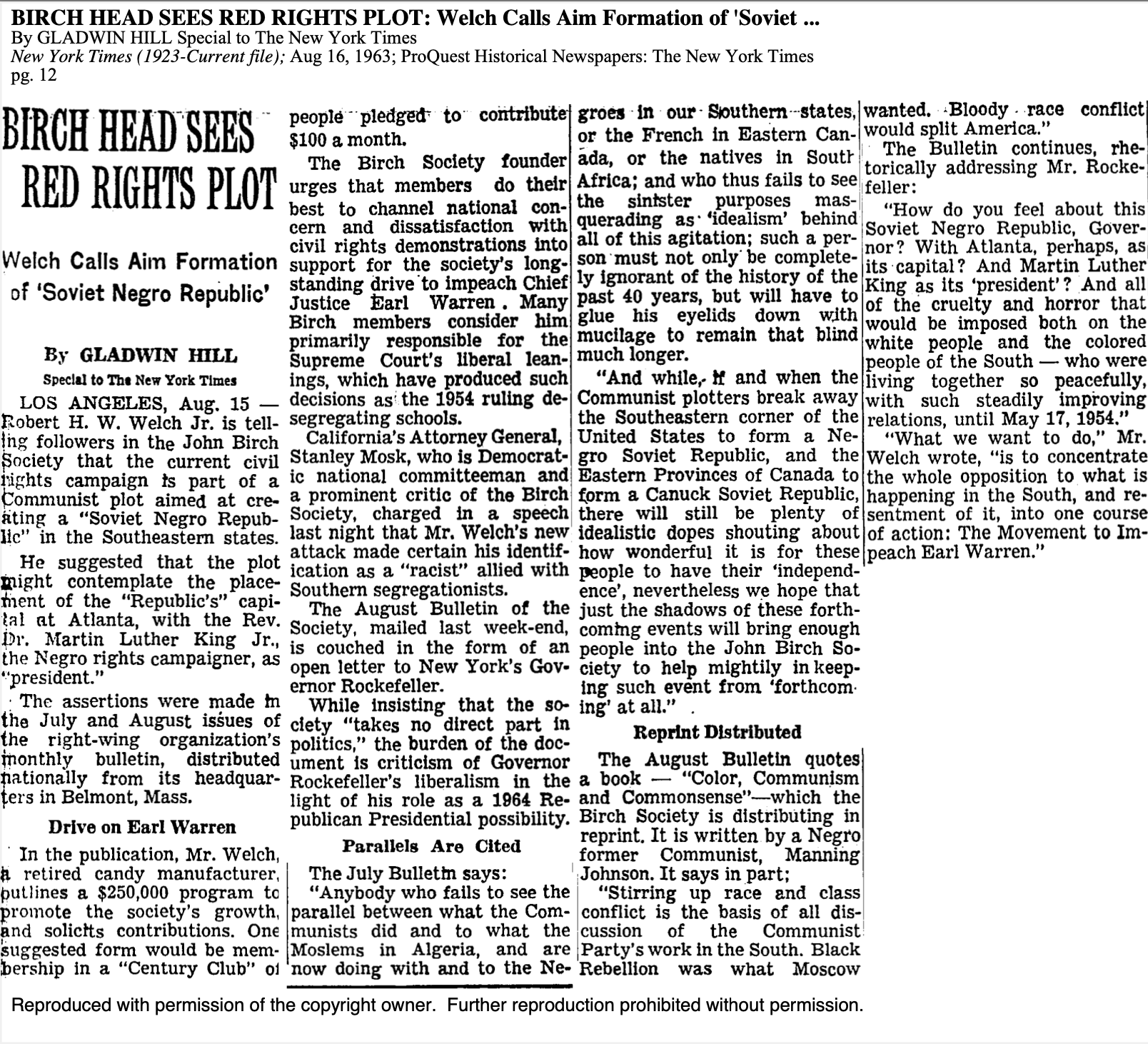
And so… here I am, at age 48, reading this article from The New Yorker about the past — and possible future — of the Republican Party. Over the years, I’ve been able to push the more extreme right-wing and conspiratorial views of my family to the periphery and just focus on being cordial and getting along. But now that extreme right-wing and conspiratorial views form the mainstream of the Republican Party, it’s a lot harder to ignore. Especially when I read that the founder of the John Birch Society espoused that the civil rights movement of the 60’s would lead to a “Soviet Negro Republic” and needed to be halted.

Right.

African-Americans needed to be denied the right to vote (among other liberties) because they were going to carve out a separate nation with MLK as their president. While that forecast was obviously pretty far off base, the article below from the New York Times was published a full decade before I was born into my JBS household. But my parents joined the Birch Society in 1960 or 1961, I believe. That means they have been stewing in this type of thought for 60+ years.

I’m not sure what, if anything, to do with this information other than tuck it away and recognize it as one of the “Founding Documents” of the current Republican Party. I’m sure it was merely an oversight, but somehow this forecast and warning of a Soviet Negro Republic was never mentioned around the John Birch camp nightly campfire.

Dreaming

I don’t often remember my dreams. Maybe once every few years will I have a dream that sticks with me longer than it takes to think about waking up.

A few days ago, I had a memorable one.

For whatever reason, former president Donald J. Trump was trying to kill me and my wife. Being sane people, my wife and I decided to flee our hometown to the relative safety of the home of my wife’s parents, roughly 80 miles distant.

Given the ambiguity of dreams, I can’t say exactly where we were in our flight to safety but at some point along the way, we were caught. Trump, in a gaudy white Cadillac with gold trim, rolled up along side us as we walked along a dirt road. There was some unknown and threatening lurker in the front passenger seat, Don Jr. was in the rear passenger seat and a second unknown lurker was in the rear seat on the driver’s side.

For whatever logic that made perfect sense in the dream, I had my car keys in hand. Why weren’t we driving the car? I don’t know. But what I do know is that I noticed Don Jr.’s window was rolled down. I casually stepped forward and shoved my car key into his neck. Blood spurted, he died. Trump slowly drove off, arguing some indistinguishable fine point with his lurkers.

And that, my friends, is the only dream I have remembered in months and months and months.

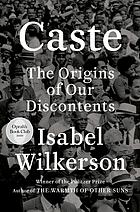
Caste: The Origins of Our Discontents — by Isabel Wilkerson

Goaded on by then-President Trump, a mob of nationalists, white nationalists, white supremacists, QAnon believers and minions waving Confederate flags stormed the Capital building on January 6th, 2021, with the goal of stopping the certification of Joe Biden’s election and Electoral College victory.

In a stroke of brilliant timing on my part, I had been reading Caste throughout November and December so I had a new lens through which to peer as I watched the chaos unfold.

How did we get here? Simple enough, as it turns out. America was built on the idea that whites (and more specifically, white men) are the divinely destined rulers of the American land. To various diminishing degrees, Blacks, natives, Hispanics, Asians, immigrants, LGBTQ+, women, etc., all fall somewhere further down the ladder of caste. What we saw on January 6th was, by and large, white men clinging to their station at the top of the American caste system.

For years, many in my social circle (including myself) have long bemoaned working-class white voters voting against their immediate economic self-interest by voting Republican. Why would they do that, my white ass would wonder. Aha. Wilkerson lays this bare. White working-class voters aren’t voting against their self-interests, not in the least. Not by a long shot. They are voting to uphold a caste system that places them at the top of America’s caste hierarchy. Simple. Duh. “Maintaining the caste system as it had always been was in their interest. And some were willing to accept short-term discomfort, forgo health insurance, risk contamination of the water and air, and even die to protect their long-term interest in the hierarchy as they had known it.” Well, shiite. I guess that’s pretty simple, isn’t it? In order to convince voters from a high caste that something as straightforward as clean water is something worth supporting and voting for, it’s only worth supporting and voting for if the lower caste only has less clean water. If everyone wins, that’s a loss for the upper caste.

Wilkerson structures her work by drawing out parallels and symmetries between America’s caste system, India and Nazi Germany. For me, it was her comparison of America to the Nazi reign that kept my jaw on the floor.

Let’s shift back 80+ years and take a peek at the beginnings of Nazi Germany. In 1934, the Nazi party had come to power but hadn’t fully cemented their grasp on the institutions and structures that would allow them to eventually kill millions. Looking for inspiration on how to scapegoat, subjugate and dehumanize an entire segment of society, a small group of Nazi politicians, lawyers and sympathizers gathered for a study session. Being Nazis, they took meticulous meeting notes. And Wilkerson tracked down those notes. Being ever-efficient, one of the attorneys in the room had already completed a foreign student exchange as an undergraduate at university in the American South and he recommended looking to America as an inspiration and role model. And so they did. After extensively studying American Jim Crow laws and the systematic degrading of African Americans, the Nazis — yes, the Nazis — decided that America went further than necessary with our racially based segregationist approaches. They concluded that Germany could obtain their goals without being such… uh… Nazis.

The linchpin to the Nazi’s plan can be boiled down to the concept of caste. The ability to get an entire population (working-class whites, perhaps? or German gentiles?) to view themselves as superior and more naturally deserving of better jobs, better schools, better neighborhoods, etc., than lower castes is all that it takes to justify genocide. And then… here’s the trick: with such a superiority structure in place, resentment of lower castes can be kept simmering on a low boil when the good jobs and good schools and good neighborhoods don’t materialize as advertised.

The mob that invaded the Capital of the United States of America, encouraged and emboldened by the previous President of the United States of America, are pissed that their jobs and schools and neighborhoods aren’t what they want them to be. Look where they are directing their anger.

Worth reading? Yep. 5 stars. Go find a copy here: http://www.worldcat.org/oclc/1193280092