I recently finished listening to the audiobook version of this title. Given my listening habits, it took me the better part of a year to make it through the 21 hours. Normally, if I take such long breaks from a book, that means I’m not going to finish it. Not the case with this one. Demon, the protagonist, had a way of fading away for a few weeks at a time but then he would bubble to the surface of m’brain and I’d feel the urge to check back in on his story.
Part of the reason it took me so long to get through this one was that I felt the middle 1/3 of the book slipped into a repetitive and depressing cycle of Demon — an Appalachian middle-schooler thrust into the foster system when his single mom OD’ed — having some horribly tragic event befall him, only for him to somehow cobble a life together and a path forward… until the next tragedy or piece of crappy luck struck. I remember thinking “Dang. How much bad luck can one kid endure?” but I guess resilience is a requirement of both the reader and the character.
Set largely in the heyday of Purdue Pharma’s and the Sackler family’s ravaging of Appalachian culture via bottles of hydrocodone, Demon Copperhead is the deep dive, 21 hour version of The Matt Mitchell Music Company’s song, Bootstrap Nation. Side note: while we’re on the topic, if anyone wants to subject themselves to a sickening and sobering peek behind the source of America’s opioid epidemic, check out Patrick Radden Keefe’s Empire of Pain.
I’ll steer clear of spoilers here but I will say this about the way Kingsolver wrapped up the novel: it was worth the effort. Go grab yourself a copy and settle in for a swirling eddy of neglect, abuse, bad luck, and bad choices splashing against the occasional rocks of kindness, compassion, and connection.
I find the human brain to be endlessly fascinating. At least until the recent advent of AI’s hallucinations, it was our only known source of flights of fancy, musings, dreaming up gods and religions, and generally trying to make sense of this spinning world.
I usually take the combo of my brain and my body as being “me.” That unique combo has, with one notable exception in the early 2000’s, always more or less marched in lockstep and functioned as a singular unit. But what is the “self,” if and when the mind and body go their separate ways?
The bulk of Sacks’ work here is an exploration of cases where the mind/body fusion is broken or otherwise confused. A few sample cases: A man who doesn’t recognize his own left leg (and is disgusted by it’s presence), a woman who lost all proprioception (the ability to tell where your body parts are in time/space without needing to get visual confirmation to make that determination). A man whose brain could not process images from the left side of his field of view. A man whose very being ceased to exist at a certain point in his life, leaving him to live in a state of suspended animation from his midlife onward. A man who lost the ability to recognize faces; not just the ability to recall who was who, but literally not being able to tell the difference between a fire hydrant and a human child.
All fascinating stuff.
Coming back to my personal episode, in 2001, I was walking up our basement stairs in our little shack of a house in North Seattle when I realized that my right calf muscle wasn’t working as it should. I couldn’t do a heel lift on my right leg. There was some disconnections between my right calf muscle and brain… the message just didn’t get through. I went through a few rounds of neurological testing, got checked for Parkinson’s (not as much fun as it sounds) and, after a few weeks of doctors shrugging and giving me the “let’s wait and see” advice, the muscle slowly started to respond to signals from my brain. It was a small enough issue that I could go hours at a time without even remember the problem existed, but it was a disconcerting period in my life. What if the symptoms extended up and/or down my leg? What if it moved over to my left leg?
Aside from that weird little blip, I think the closest lack of proprioception experience I can come up happened when I went into the dentist just a few weeks ago for my routine cleaning. It was time to have a set of x-rays taken and as the dental hygienist was wedging various wheelbarrow-sized equipment into my mouth to take the pictures, I lost all sense of control and placement of my tongue. Was my tongue in the way? Was it out of the way? Was it doing something weird/slightly obscene? I don’t know, because my tongue proprioceptors seemed to check out for a few minutes. While not an exact match, that’s pretty damn close to what I felt with my calf. A part of my body just seemed to be hanging around but lacking a connection to my brain. Super weird. And the thought of having that experience extended to my entire body is simply terrifying.
If anyone has any interest in such oddities of the human experience, Sacks is a fluid, entertaining writer who is able to translate his professional neurologist expertise and package it up in a way to make it accessible to the laity.
Indigenous pagans from times before history. Russians. Germans. Swedes. Poles. Lithuanians. The Russian Orthodox Church. Crusaders. Mercenaries. The Catholic Church. Seafaring merchants. From the early 1200’s through the early 1700’s (the timespan within the focus of this book), the control of Riga sloshed around between these competing — and occasionally allied — forces like beer in a nearly empty keg on a boat in heavy seas. A clunky sentence? Yes, but it also captures the frothiness and chaos of Riga.
Not being any sort of a northern European history buff, I went into this book with some trepidation, fearing it would be overly academic and inaccessible to newbs such as myself. I’m happy to report that with the judicious use of skipping forward a page or two here and there, I came out the other side with an appreciation for the unique and overlooked role that Riga has played in European history.
Fun fact: I never knew that there was a northern front to the Crusades. With 100% of the imagery of the Crusades in my mind being focused on the Holy Land abutting the Mediterranean, there was also a long-running effort by the Roman Catholic Church to convert pagans in the Baltic regions of northern Europe to Christianity. Through a combination of the cross, commerce, coercion and the crossbow, the pagan tribes eventually succumbed and/or formed alliances with the arriving forces. For those who refused to acquiesce and acknowledge the radiant beauty of the love of the Lord Jesus Christ… those people were erased from the landscape. As gawd would have wanted.
Fun fact #2: For Christians who joined the Crusades in the fight to retake Jerusalem from the Muslims (mission accomplished!), fighters could be granted up to a lifetime’s worth of indulgences by the church. Righteous, dude. For those willing to take up arms and head off to Riga and Europe’s northern climes, one year’s worth of indulgences would be granted. One year?! Pray tell, dear Pope, how the hell does that even work? Do I get to pick the year? Is it randomly selected? If so, by whom? Is it selected before or after my term of service? Can it be a year in the future or does it have to be for deeds that have already been completed? Does it have to be a single calendar year or can it be a fiscal year? Can I (or the indulgence grantor) pick and choose specific minutes/hours/days/weeks/months that would add up to a year? So. Many. Questions.
At any rate, within the span of this book’s focus (after the early 1700’s, Riga slipped into two centuries of Russian tsarist rule), Riga saw half a millennium of constantly morphing ruling interests. But in the end… after breaking away from the German empire in the aftermath of WWI only to be forcibly incorporated into the Soviet Union, only to be invaded and occupied by Nazi Germany and only to be re-occupied by the Soviets at the end of WWII and finally becoming an independent parliamentary republic following the collapse of the USSR, the most unexpected of all outcomes is that since 1991, Riga has stood as the capital city of its own sovereign territory. History whiplash.
Will Riga’s indepence be a permanent and lasting thing? History seems to indicate that we should check back here in a few years. In the meantime, go track down a copy of this work for yourself: https://search.worldcat.org/en/title/1090904513
And if you want to kick some of this history around with Dr. O’Connor, go hang out at your local disc golf course or join a game of Risk. Listen for the muffled swearing and you will probably have found your guy.
Damn. Prepare to say this over and over as you read this book.
I don’t think I’ve ever read a book where I involuntarily said damn out loud so many times and with so many different intonations. There were plenty of “Daaaaamns,” as in “Oh, yeah. That’s bad. We’re screwed,” but also a number of “Damns!” and “Damnity damns!” along the lines of “That’s mind-blowing!”
But before we dive into all the damns, a bit of background first. If you aren’t already familiar with Kurzweil, go Google him and browse around for a few minutes. He was the first to develop print-to-speech scanning technology (Stevie Wonder was his first customer), he’s the inventor of the Kurzweil Keyboard (here’s an interesting short video about the development of that technology with a brief mention of the upcoming role of AI in music), he’s spent his entire life in computers/high tech and he has a long track record of guessing correctly about upcoming technological advances. Not only is he deep in the AI world, he’s able to report back out to the rest of us what he sees on the horizon.
And now, back to the swearing.
Moore’s Law. Most are familiar with the concept as it’s one of the bedrocks of technological advancement over the past 60+ years. While not actually a law like the laws of physics, it’s the fact that computing power tends to double roughly every 18-months while holding costs steady. That means that in 2026, I should be able to purchase 2x the computing power than I can today with the same hit to my wallet. We’ve been on this doubling trajectory for long enough now that whole new vistas are opening up on the horizon of what it is to be human.
The first “Damn!” of the book: Kurzweil applies Moore’s law going back to the Big Bang. Up to this point in my life, I’d only considered Moore’s law as forward facing tool with a beginning point in the 20th century.
Consider this: About 10 billion years elapsed between the first atoms forming and the first molecules (on earth) becoming capable of self-replication. Then there was about another 2.9 billion year span between first life on earth and first multicellular life on earth. Another 500 million years slips by and animals start showing up. Add another 200 million years to the clock and mammals appear.
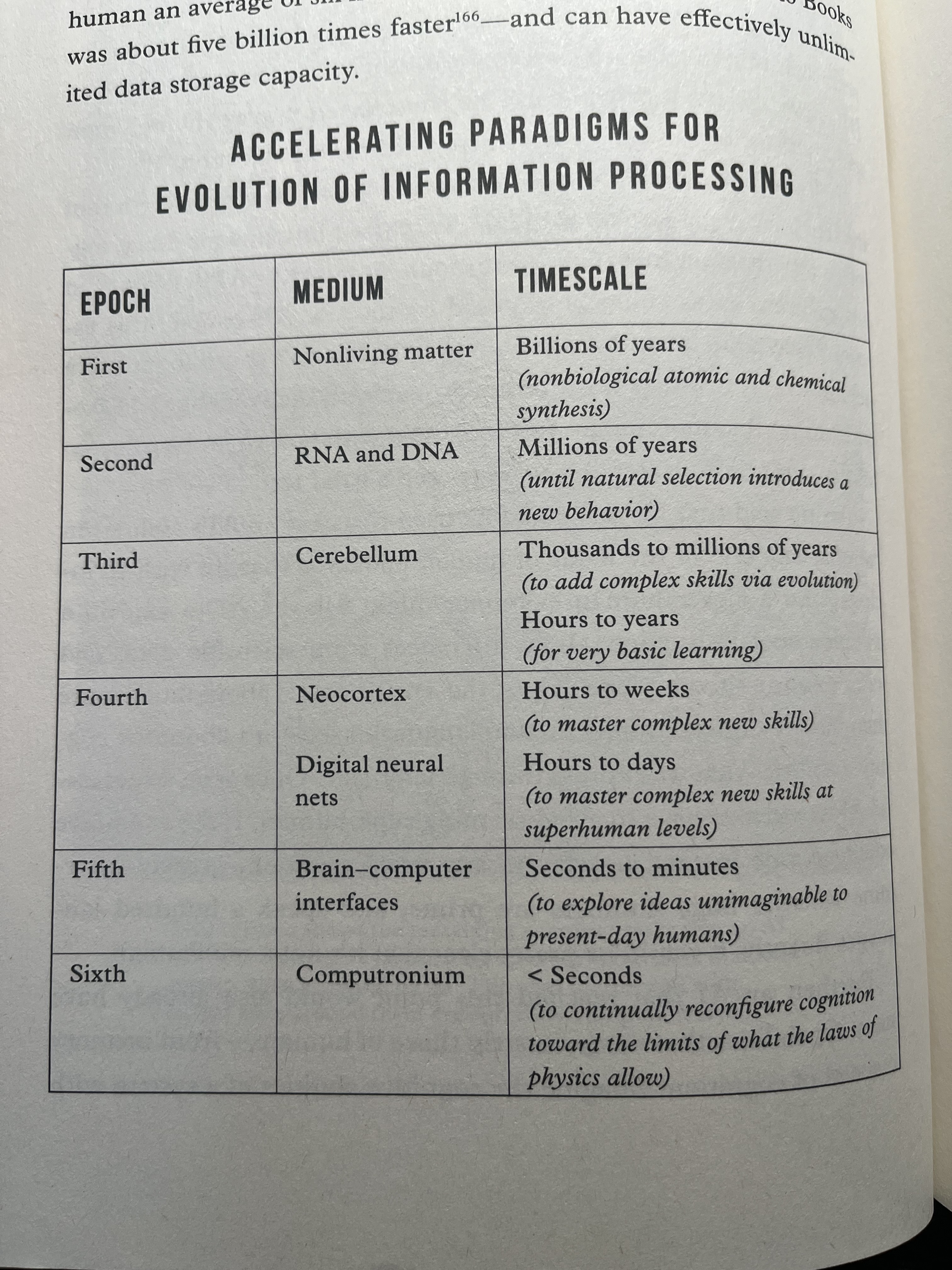
Looking at life as the ability/power to process information, there is a trend emerging of accelerating change. “Focusing on the brain, the length of time between the first development of primitive nerve nets and the emergence of the earliest centralized, tripartite brain was somewhere over 100 million years. The first basic neocortex didn’t appear for another 350 million to 400 million years, and it took another 200 million years or so for the modern human brain to evolve.” 200 million years for modern brain development vs. 100 years-ish to hook our modern brains up to a radically expanded brain. Hmm. Damn.
In a chart, here’s the progression of how long it takes us to process information and learn new stuff:
So what happens when, according to Kurzweil’s prediction, humans are able to directly connect our neocortexes to the web? Daaaamn. At that point, who exactly am I? And with the ongoing exponential growth of computing power (with nano-scale computers projected to provide the computing power of 100 trillion human brains in the approximate volume of a single, current day human brain), the options become nearly boundless. Download the neuromuscular set of instructions for the ideal disc golf drive? Seems doable. Become a master music composer overnight? Why not? Holy damn.
Things are going to get weird in the coming decades. The pace of change we’ve seen over the past few generations is only going to accelerate. When I consider that my paternal grandfather was born in 1895 and lived a good chunk of his life basically in the Agricultural Age + Iron Age, I wonder what my [possible? eventual?] grandkids’ view on me will be.
Speaking of the Agricultural Age… Kurzweil spends a good amount of energy talking about the future of jobs and AI. Where are all of the current jobs going to go and what will replace them? In the 1890’s, over 40% of the American workforce was engaged in agriculture. We’re now sitting at 1%. Whether that has been a good thing for our society or not (Wendell Berry would take the adamant stance that it has not), the point remains that folks found jobs.
The other point is that even if agricultural workers in the 1940’s were told that their children, grand-children and great-grandchildren were going to become web site designers or digital video producers or Python or SQL experts, they wouldn’t have had a mental framework to make sense out of those words. Kurzweil’s argument with AI is that it is going to be such a radically different world that we can’t begin to explain to ourselves what it will look like.
Okay. I guess. But that’s not exactly comforting. Damn.
While it took 70+ years for ag jobs to drop from 53% of the workforce in 1860 to 21% in 1930, that was a relatively long timeframe. AI and massive computing power are poised to disrupt our current structures much more rapidly. What if, in the span of the next decade, nearly all trucking and delivery jobs were wiped away by autonomous driving? What if every radiologist were replaced over night by (better performing) AI tools? Bookkeepers? Fast food workers? My sense is that when cultural changes happen over the course of a generation or more, society has a chance to react. This time through the cycle, I’m not convinced that our social structures, regulatory systems, legal systems and safety nets are up to the task for the disruptions that Kurzweil lays out. Daaaaamn.
Speaking of social structures, our brave new future and who gets to enjoy (?) it, Kurzweil makes the assertion that a “kid today can access all of human knowledge with her mobile device.”
I think that’s a dangerous misstatement. And therein lies a significant flaw in Kurtzweil’s argument that AI’s benefits will be ubiquitous. As a business research librarian, I know that my library is spending upwards of $80,000 per year to provide “free” access to top-shelf business research tools and resources. The good stuff is not free. I don’t think it ever has been and I don’t anticipate it ever being so. No one is getting access to all of human knowledge on a mobile device without paying for the good stuff. So I guess that’s a good thing for libraries? Maybe? Hot damn!
As a framework for assessing any given technology’s societal benefit, I think it’s useful to ask who will have access to this technology? Who will be able to control the use of this technology? Will the control be primarily democratic or will it require bureaucratic, centralized organizations to manage it? Who will primarily benefit from the use of this technology? And mainly, who can afford it? On the plus side of the equation, I do think (despite the paragraph above), that access to AI will be relatively widespread. It’s not a technology like nuclear power that requires massive capital outlays or highly specific and specialized knowledge to make it hum. That’s the upside.
The downside is that AI will, in Kurzweil’s view, have the ability to custom design infectious diseases and create all sorts of mayhem. And… it will be in the hands of the average Joe. Damn. And daaaaamn.
But… before you despair too deeply, dear reader, here’s Kurzweil’s closing paragraph: Overall, we should be cautiously optimistic. While AI is creating new technical threats, it will also radically enhance our ability to deal with those threats. As for abuse, since these methods will enhance our intelligence regardless of our values, they can be used for both promise and peril. We should thus work toward a world where the powers of AI are broadly distributed, so that its effects reflect the values of humanity as a whole.
It has been a while, folks. My last post here was early February, 2024. A lot has happened since then. We sold the big house and drastically downsized into a condo. Both kids have moved out into their own apartments, positioning us as empty nesters. The condo is a nine-minute walk to the Central Library. It’s a six-minute walk down to a swimming hole at the river. Pretty groovy.
Big changes, but good ones. The sale of the big house allowed us to pay off our property on the coast and pay off some other debts while still putting us in a position to have the condo paid off in roughly two years. Big sighs of relief to have that financial stress off our shoulders.
After making it through the stress of selling/buying/moving, that means I need to get back to doing some reading and keeping some notes to self here. So here we go.
Winner of the 2019 Pulitzer Prize for Fiction, The Overstory is a tale of layering, braiding, leafing, branching and intertwining tales of North America trees and some of the humans who inhabit that world. The protagonist here isn’t a person, but rather how trees of various ages and species and location manage to tie an amalgamation of humans together. It’s a pretty neat literary trick that Powers has pulled off here.
A couple lines/points that have stuck with me since I finished the book earlier this summer:
Trees sprang into being here on Earth about 400 million years ago. That’s 400,000,000 years. Four hundred million years, if you want to spell it with letters. Every tree we see is a successful experiment that has been running for a very long time.
Humans are not the important part of the this book. If all trends continue on our current path, I’m guessing we’ll be realizing we’re not the important part of the story of life either.
Human civilization, in its current form, would most likely not exist without trees. Take look around at our built environment and chances are, trees form the basic building blocks of what you see. Not just the structures of our homes and cities, our earlier forms of transportation and early weaponry, but they also form a significant chunk of our current food supply.
I should have bookmarked this passage when I read it so that I could easily quote it verbatim, but it went something like this: In the DSM 5 discussion of delusional behavior, delusion is described purely as an individualistic affliction. If the broader culture around you doesn’t view something as delusional (such as destroying the structure that supports life, worshiping the great flying spaghetti monster, etc.), then it isn’t delusional. If you find yourself fighting against something that is largely culturally agreed upon (that earth was created for the enjoyment and utility of humans), you may then be deemed delusional.
One quibble with the book (and a possible spoiler alert): Powers floats the possibility that the salvation of the world will come through the rapid deployment of AI as that will allow for inter-species communication. That would be cool I guess but I also have to remember that when Europeans encountered beings in the New World, there was discussion of whether the indigenous peoples were actually human. Eventually being deemed human didn’t seem to afford much protection to Native Americans so…. yeaaaaah.
Since these past few months have been a bit of a blur, I didn’t keep any notes as I was reading this but I will say this: if you’re looking for a well-written, poetic, sad and — at times — angry ode to the trees, this is your book. A+.
Fact #1: Lacking some significant medical breakthroughs, if you’re reading this sometime in 2024, you’re probably going to die within a single-digit number of decades.
Fact #2: The entire medical profession has been incredibly well-trained and well-equipped to keep us from dying.
Combining Fact #1 with Fact #2 leads to a bit of conflict and unease in our society.
But first, let’s rewind the clock a generation or two and look at how we got here.
Prior to the 1930s, families provided the care and support for their elderly family members until their death. If you didn’t have a family to support you, then you had a couple of different options.
Option #1 is the best choice: have bags and bags of money lying around to hire help in old age. The folks fitting that profile were predictably well taken care of. Option #2 was considerably more bleak. This involved being placed in an asylum/poorhouse with a whole bunch of other people with no family to care for them. By all accounts, those were some dismal and dehumanizing places to live.
In a nifty confluence of events, at roughly the same time that Social Security rolled out and started providing financial support to those seniors who had no family nor funds to support them in their old age, the medical advances developed during World War II started to lap up on our shores. Old age quickly moved from being merely another stage of life with a predictably precipitous end and came to be viewed more as a medical problem that could be fixed with our newfound technologies like antibiotics and surgical techniques. The solution for old age was pretty obvious: put old people in hospitals.
That approach worked for a couple of years, but then hospitals started to realize that their beds were filling up with people who weren’t dying nor getting well. This led to a couple different efforts to addressed the problem. Effort #1 was that in the 1950s and into the 1960s, the federal government dumped billions of dollars into the construction of new hospitals across the nation. But as it became clear that hospitals couldn’t keep up with demand for their beds, in the late ’50s and into the early ’60s, a new form of care came into being: the nursing home.
As the name implies, nursing homes were designed to provide care to the sick and elderly. The structure was built around the idea of the patient being, well, a patient. The operating and business practices of nursing homes were designed to promote the efficiency of the facility and not necessarily caring so much about the needs and desires of the patients.
Enter a new idea: the assisted living facility. Assisted living, at its best, tries to hand the autonomy of life decisions back to the resident in terms of what time they shower, what time they wake up, what time they go to bed, what they eat, when they eat, who they have over as visitors and/or lovers, etc. All this just happens to occur where skilled nursing is available just down the hall.
Preserving that sense of self and independence is, in my mind, the guiding star of what medicine should be aiming to provide and what I should be asking of my health care providers now that I am, ahem… old.
With medical science now able to prolong life far beyond what had been dreamt of in years past, the question now becomes one of when scientific and technological prowess need to recognize human mortality. As Gawande points out, he was trained to fix problems. If you have cancer, do some surgery. Do some chemo. Do some radiation. And if those remedies cause some cascading series of issues and traumas, those are to be dealt with those as they come. The medical profession has gotten so good at addressing individual medical problems that human existence can get whittled down to the point where people are kept alive without actually living.
Having arrived at the ripe age of nearly 51 years old now, my takeaway from this book is that we all need to be thinking about what it is we want from our medical care. What is it that we are willing to give up to get to a certain outcome? If what gives life meaning is stripped away and a person is left as a breathing stump of a human in a bed, have we really made any progress?
That’s a trick question.
Gawande’s point is that the question above doesn’t have a single answer. The answer varies from one person to another to another. And the range of answers varies significantly. For some who are facing rounds of chemo and surgery, they just want to make it out of that process with the ability to watch football on TV and eat ice cream. That’s enough for them. For others, that outcome sounds horrific and not worth the trade.
Those conversations, as awkward as they might be, are the path forward that allows patients, families, caregivers, and doctors the ability to determine when to press ahead with treatments and when to say “What do you want out of your remaining days, however many they might be?”.
When applying for political asylum, should you wail, emote, and be purely raw with your emotions as you recount the horrors that led you to apply for asylum in the first place? Or should you take the stoic approach, reciting dates, facts, names of torturers, names of rapists, etc., with as little emotional overlay as possible?
It’s a trick question.
It all depends on the asylum intake officer on the other side of the desk. Some officers will connect with the emotional appeal, others will shrug it off as an act that is being overplayed. Conversely, some officers will interpret a bullet-point listing of transgressions as lacking in human emotion. If it were really that bad, wouldn’t there be more of an outward expression of trauma? And vice versa.
If — lawd forbid — you are ever in need of pain medications to get through your day, at a certain point, you’re going to have to convince a doctor that you’re truly in pain and not just seeking pills. After speaking with a number of doctors and pain specialists, Nayeri settles on this as the ideal approach for those seeking pain relief: I know I’ve had pain medications before, doc — some worked better than others — but I don’t care what it is you give me, I just want to not deal with this pain. This approach sidesteps the issues of appearing to be hooked on a particular medication (Just give me the Oxy, Doc!) and it hands the control of the “what” and the “how” of the pain treatment over to the professional. Not too demanding, not too specific. But a patient in need of pain management also walks a line akin to applying for asylum in that the decision comes down to the particular doctor in charge of making that decision on that particular day. Okay, good to know.
I went into this book thinking that I was going to be led to some deep insight that would allow me to crack the cult of Trump and break down the conspiratorial mindset. This was a good read but, unfortunately, Nayeri didn’t get me there. It’s not her fault as it’s a big ask of an author to intuit the wants of this particular reader before she hit the “send” button to her publisher.
As it turns out, the author’s brother-in-law had lifelong struggles with mental health issues. About 2/3rds of the way through the book, it becomes clear that while the author does a good job of pulling together multiple threads to weave together a book about belief and believing (asylum seekers, pain patients, religion, etc.), it’s really a reckoning of her relationship with her husband’s brother.
My takeaway? Err on the side of “innocent until proven guilty”, especially when it comes to issues of the powerless beseeching the powerful to believe their stories.
I am who I am. I don’t feel particularly pressured to be any more myself or any less myself. I’m a middle-aged white guy with an unruly beard typing this on a Mac. Pretty much sums up a lot of things. Sure, I get nudges from family to come back to the conservative religious fold and while that brings a certain burden with it, it’s not a deal breaker. I’m still welcome at family gatherings, despite my various shortcomings.
This election season, however, has been tough. In my mind, and in the minds of most Americans it would appear, there is no middle ground between us and them. Despite a jaw-droppingly bad choice in VP running mate, my 2020 self has convinced myself that, lacking a viable alternative, I could have conceivably voted for a John McCain. Or a Mitt Romney. But when our sitting president makes public announcements defending Nazis and white supremacists, well… shit. That doesn’t leave a whole lot of middle ground or space to agree to disagree. Fine, we can discuss the efficacy of tariffs and various monetary policy approaches, but, uh, the guy pushing those particular policies is a racist asshole. It’s hard to get around the reality that character and worldview will eventually bleed into policy.
It has been against this backdrop that I’ve been reading Ellison this fall. Invisible Man was first published in 1947. Compared with this last year, I can’t say that America has made much progress in the intervening 73 years. But then again, as already stated, I’m a middle-aged white guy with an unruly beard and am probably not the authoritative voice people should turn to for insight into the state of America’s racial affairs.
But who is the authoritative voice?
Well… that’s complicated isn’t it? And Ellison nails it in having the voice and thoughts of his protagonist remain nameless. Ellison gives the reader nothing upon which to hang a mental picture. Jim? Tom? Duke? As names for a black man in a novel set in the 1930s/’40s, those all have their own evocative meanings. But in remaining anonymous, the narrator is a blank slate onto which the reader can project their own version of reality.
As the tale unravels, what becomes clear is that the man driving the plot is at times too black for some blacks and at the same time too white for some blacks and at the same time too black for some whites and at the same time too white for some whites. He’s always threatening to someone — often simultaneously and for conflicting reasons — and it’s a game that can’t be won.
But back to me. I’m a middle-aged white guy who can walk into pretty much any setting — from my local disc golf course to a school fundraiser to a concert to a City Council hearing to a corporate boardroom to a university classroom — and not give two shits or two seconds of thought about how white to be, or not to be. As if I could even change it, even if I wanted to. That’s a gift. A luxury. Spreading and sharing that gift should be a focus of our nation.
For those of us wondering how American politics and political discourse got to the point where it is today, Hersh’s bit of work goes a long way to explaining the path that got us here.
While there are any number of crosswinds blowing across the barren plains of the American political landscape, Hersh lays the bulk of the blame on one particular subset of the population. I was all set for him to take down the big money interests, the Citizen’s United decision, the “deregulate everything at all costs” camp, gerrymandering, white nationalists, etc. Nope, he has his sights set elsewhere.
Drum roll, please.
And the winner is… white, educated, middle-class liberals.
Dammit.
For much of America’s white political left, political activism has become less of something to be engaged in and more of something to be observed. Politics has become a team sport for many. We get up in the morning, go to our preferred media outlet to check the most recent scores of how our team did yesterday, read about the pitching matchups scheduled for this afternoon and then, tomorrow morning, check back in on the results from today’s contest. We might engage in some online debate about who is the best designated hitter (or best choice for a VP pick or most productive middle linebacker) but let’s face it: it’s a hobby.
Fact #1: “Being white and financially comfortable makes it hard to understand a sense of fear that would push people to want power. Being white and comfortable means already having enough power. Only if you don’t need more power than you already have could politics be for fun. It’s when you don’t have as much as you need — that’s when politics is for power.”
Facts #2 – 18: “Within a political party, a union, or a church, [individual action] comes with too great a risk to the brand, or so organizations have learned. Over time, the risks have led to serious shifts in how organizations encourage individuals to participate. Party organizations want you to come around to them during elections, give some money, knock on some doors with a canned script, follow a procedure that keeps you from embarrassing them. Because the forms of these engagements feel so shallow, because they lack all substance … not many of us want to do that. To get our political fix, we can’t go to the local committee because the local committee doesn’t do anything interesting. Hobbyism fills the vacuum. Our taste for not dirtying our hands with actual politics combined with organizations’ desire to maintain top-down control results in many of us having a hard time learning how to channel our political energy in useful ways.”
Hersh’s solution? Hershlution™?
Recognize that politics (and resulting power) isn’t an intellectual pursuit about who has the best ideas. Case in point: political debates on Facebook.
Find a problem that other people are having and work to fix it. That’s where political power comes from. Case in point: my library is solving an ongoing problem for Spokane’s business community. Over the last decade we took what had been a political foe and turned them into a political cheerleader. We did this not by arguing our worth, but by solving a problem.
White liberals need to stop decrying “identity politics” as being divisive. Identity politics seem to be the only thing that has worked on the political left (Voting rights, civil rights, ADA, gay rights, etc.) so why would we not engage in and support identity politics? Oh, because we’re white. Right. Got it.
Find ways to be politically engaged that go beyond updating the daily scorecard. Take a percentage of the time that we currently use to “keep informed” and put that toward some other effort.
What is that “some other effort”? It’s up to you. A couple tips, however: make it local (the more hyperlocal the better) and make it meaningful to you. The broadest definition that I can think of is this: help your neighbors. Establish trust that you aren’t out to kill them.
Once that baseline has been established (it really is as rudimentary as that), only then do doors open up to political persuasion… and yes, power.
In 1942, a twenty-eight-year old member of the Polish underground, Jan Karski, left on a mission from Nazi-controlled Poland to travel to England and from there on to America. His goal was to inform world leaders of the horrors being inflicted on the Jewish populations under German control and implore the world to act.
In June, 1943, Karski met with U.S. Supreme Court Justice Felix Frankfurter, himself a Jew. After hearing Karski’s description of the clearing of the Warsaw Ghetto, exterminations in the concentration camps and atrocities, Frankfurter’s response was this: “Mr. Karski, a man like me talking to a man like you must be totally frank. So I must say I am unable to believe what you told me.” When a colleague of Karski’s attempted to add more details and weight to the argument, Frankfurter responded, “I didn’t say that this young man is lying. I said I am unable to believe him. My mind, my heart, they are made in such a way that I cannot accept it.”
Many of us find ourselves in Frankfurt’s position when it comes to climate change. We know, but we don’t believe. We know the projections and estimates. But we don’t believe the projections and estimates fall within our spheres of influence. And herein lies the thrust of Foer’s work.
I received this book as a Christmas gift from my cousin-in-law and at first glance I was dreading (another) book discussing the crashing and burning of the climate, chapter after chapter filled with tightening spirals of dire and gloomy data.
That is not this book.
This book assumes the reader already knows the data and estimates and projections. Foer then sets out to map the contours of our inaction. Sure, there are graphs and charts and numbers thrown in, but they really are beside the point. Knowing what we know, why are we not acting like we know what we know?
Most chapters in the book are presented in readily digestible sections of about five pages each. With one exception, which forms the heart of the book. This exception is a chapter entitled “Dispute with the Soul.” In this lengthy segment the reader is given a chair in the corner of the room while Foer debates with himself the causes of his inaction.
Does he believe that a technological solution will save us all?
Does he believe that there is nothing to be believed in?
Does he believe that humans are destined to consume their supporting environment, regardless of location?
Does he believe that he has any ability to change the outcome, one way or the other?
Throughout Foer’s conversation with himself, the takeaway is that the most important metric in terms of our individual impact on the world is not our distance from unattainable perfection but our proximity to unforgivable inaction. Our desire to avoid being caught up in inconsistencies that run counter to a certain ethic of care (imported Canadian pine shavings for my compost toilet, anyone?) leads us to a failure to act in a manner that reflects how dire things are. We have to get over that. We have to know that any action we take on behalf of the biosphere is going to be imperfect and flawed. And that’s okay. But what is unforgivable is inaction.
Oh, and yes, getting back to the actual title of the book: Foer suggests that if we all elected to not eat any animal-based products until at least lunch time, the effects on the climate would be significant. That seems doable.

 ReMarkable