The House of Hemp and Butter: A History of Old Riga — by Kevin O’Connor

Indigenous pagans from times before history. Russians. Germans. Swedes. Poles. Lithuanians. The Russian Orthodox Church. Crusaders. Mercenaries. The Catholic Church. Seafaring merchants. From the early 1200’s through the early 1700’s (the timespan within the focus of this book), the control of Riga sloshed around between these competing — and occasionally allied — forces like beer in a nearly empty keg on a boat in heavy seas. A clunky sentence? Yes, but it also captures the frothiness and chaos of Riga.

Not being any sort of a northern European history buff, I went into this book with some trepidation, fearing it would be overly academic and inaccessible to newbs such as myself. I’m happy to report that with the judicious use of skipping forward a page or two here and there, I came out the other side with an appreciation for the unique and overlooked role that Riga has played in European history.

Fun fact: I never knew that there was a northern front to the Crusades. With 100% of the imagery of the Crusades in my mind being focused on the Holy Land abutting the Mediterranean, there was also a long-running effort by the Roman Catholic Church to convert pagans in the Baltic regions of northern Europe to Christianity. Through a combination of the cross, commerce, coercion and the crossbow, the pagan tribes eventually succumbed and/or formed alliances with the arriving forces. For those who refused to acquiesce and acknowledge the radiant beauty of the love of the Lord Jesus Christ… those people were erased from the landscape. As gawd would have wanted.

Fun fact #2: For Christians who joined the Crusades in the fight to retake Jerusalem from the Muslims (mission accomplished!), fighters could be granted up to a lifetime’s worth of indulgences by the church. Righteous, dude. For those willing to take up arms and head off to Riga and Europe’s northern climes, one year’s worth of indulgences would be granted. One year?! Pray tell, dear Pope, how the hell does that even work? Do I get to pick the year? Is it randomly selected? If so, by whom? Is it selected before or after my term of service? Can it be a year in the future or does it have to be for deeds that have already been completed? Does it have to be a single calendar year or can it be a fiscal year? Can I (or the indulgence grantor) pick and choose specific minutes/hours/days/weeks/months that would add up to a year? So. Many. Questions.

At any rate, within the span of this book’s focus (after the early 1700’s, Riga slipped into two centuries of Russian tsarist rule), Riga saw half a millennium of constantly morphing ruling interests. But in the end… after breaking away from the German empire in the aftermath of WWI only to be forcibly incorporated into the Soviet Union, only to be invaded and occupied by Nazi Germany and only to be re-occupied by the Soviets at the end of WWII and finally becoming an independent parliamentary republic following the collapse of the USSR, the most unexpected of all outcomes is that since 1991, Riga has stood as the capital city of its own sovereign territory. History whiplash.

Will Riga’s indepence be a permanent and lasting thing? History seems to indicate that we should check back here in a few years. In the meantime, go track down a copy of this work for yourself: https://search.worldcat.org/en/title/1090904513

And if you want to kick some of this history around with Dr. O’Connor, go hang out at your local disc golf course or join a game of Risk. Listen for the muffled swearing and you will probably have found your guy.

Proper role of government

According to Abraham Lincoln, ‘The legitimate object of government, is to do for the people what needs to be done, but which they cannot, by individual effort, do at all, or do so well, for themselves.”

Let’s discuss. Feel free to add comments below. Since we’re now off of Facebook’s algorithm, feel free to throw bombs. Go ahead, be inflammatory. But here’s the single ground rule: attack ideas, not the individual. Here we go.

The Singularity is Nearer: When We Merge with AI – By Ray Kurzweil

Damn. Prepare to say this over and over as you read this book.

I don’t think I’ve ever read a book where I involuntarily said damn out loud so many times and with so many different intonations. There were plenty of “Daaaaamns,” as in “Oh, yeah. That’s bad. We’re screwed,” but also a number of “Damns!” and “Damnity damns!” along the lines of “That’s mind-blowing!”

But before we dive into all the damns, a bit of background first. If you aren’t already familiar with Kurzweil, go Google him and browse around for a few minutes. He was the first to develop print-to-speech scanning technology (Stevie Wonder was his first customer), he’s the inventor of the Kurzweil Keyboard (here’s an interesting short video about the development of that technology with a brief mention of the upcoming role of AI in music), he’s spent his entire life in computers/high tech and he has a long track record of guessing correctly about upcoming technological advances. Not only is he deep in the AI world, he’s able to report back out to the rest of us what he sees on the horizon.

And now, back to the swearing.

Moore’s Law. Most are familiar with the concept as it’s one of the bedrocks of technological advancement over the past 60+ years. While not actually a law like the laws of physics, it’s the fact that computing power tends to double roughly every 18-months while holding costs steady. That means that in 2026, I should be able to purchase 2x the computing power than I can today with the same hit to my wallet. We’ve been on this doubling trajectory for long enough now that whole new vistas are opening up on the horizon of what it is to be human.

The first “Damn!” of the book: Kurzweil applies Moore’s law going back to the Big Bang. Up to this point in my life, I’d only considered Moore’s law as forward facing tool with a beginning point in the 20th century.

Consider this: About 10 billion years elapsed between the first atoms forming and the first molecules (on earth) becoming capable of self-replication. Then there was about another 2.9 billion year span between first life on earth and first multicellular life on earth. Another 500 million years slips by and animals start showing up. Add another 200 million years to the clock and mammals appear.

Looking at life as the ability/power to process information, there is a trend emerging of accelerating change. “Focusing on the brain, the length of time between the first development of primitive nerve nets and the emergence of the earliest centralized, tripartite brain was somewhere over 100 million years. The first basic neocortex didn’t appear for another 350 million to 400 million years, and it took another 200 million years or so for the modern human brain to evolve.” 200 million years for modern brain development vs. 100 years-ish to hook our modern brains up to a radically expanded brain. Hmm. Damn.

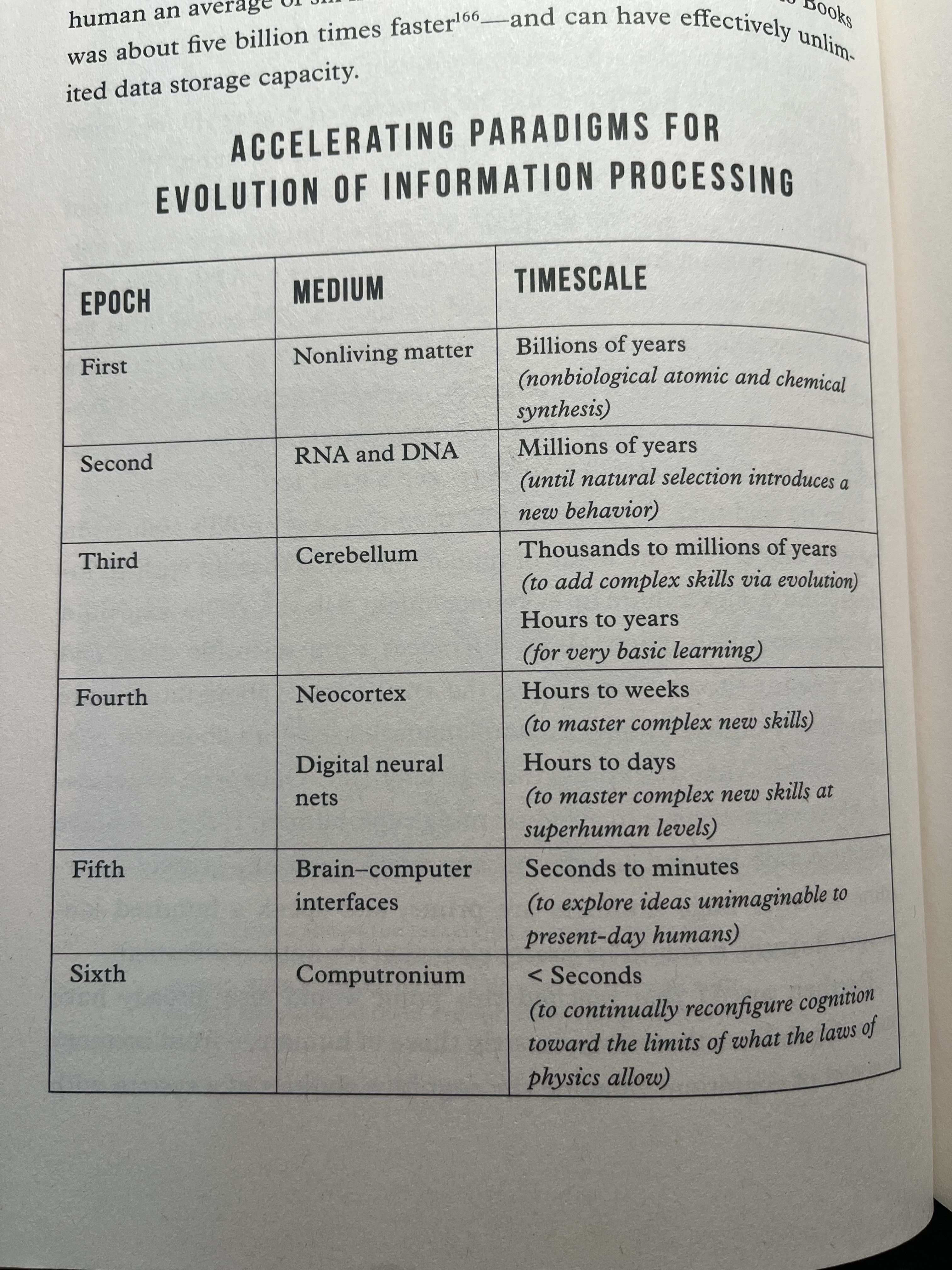
In a chart, here’s the progression of how long it takes us to process information and learn new stuff:

We humans here on earth are currently in the 4th Epoch. But we’re right at the cusp of slipping into the 5th Epoch. Articles with titles like “New brain-computer interface allows man with ALS to ‘speak’ again” are pretty commonplace these days.

So what happens when, according to Kurzweil’s prediction, humans are able to directly connect our neocortexes to the web? Daaaamn. At that point, who exactly am I? And with the ongoing exponential growth of computing power (with nano-scale computers projected to provide the computing power of 100 trillion human brains in the approximate volume of a single, current day human brain), the options become nearly boundless. Download the neuromuscular set of instructions for the ideal disc golf drive? Seems doable. Become a master music composer overnight? Why not? Holy damn.

Things are going to get weird in the coming decades. The pace of change we’ve seen over the past few generations is only going to accelerate. When I consider that my paternal grandfather was born in 1895 and lived a good chunk of his life basically in the Agricultural Age + Iron Age, I wonder what my [possible? eventual?] grandkids’ view on me will be.

Speaking of the Agricultural Age… Kurzweil spends a good amount of energy talking about the future of jobs and AI. Where are all of the current jobs going to go and what will replace them? In the 1890’s, over 40% of the American workforce was engaged in agriculture. We’re now sitting at 1%. Whether that has been a good thing for our society or not (Wendell Berry would take the adamant stance that it has not), the point remains that folks found jobs.

The other point is that even if agricultural workers in the 1940’s were told that their children, grand-children and great-grandchildren were going to become web site designers or digital video producers or Python or SQL experts, they wouldn’t have had a mental framework to make sense out of those words. Kurzweil’s argument with AI is that it is going to be such a radically different world that we can’t begin to explain to ourselves what it will look like.

Okay. I guess. But that’s not exactly comforting. Damn.

While it took 70+ years for ag jobs to drop from 53% of the workforce in 1860 to 21% in 1930, that was a relatively long timeframe. AI and massive computing power are poised to disrupt our current structures much more rapidly. What if, in the span of the next decade, nearly all trucking and delivery jobs were wiped away by autonomous driving? What if every radiologist were replaced over night by (better performing) AI tools? Bookkeepers? Fast food workers? My sense is that when cultural changes happen over the course of a generation or more, society has a chance to react. This time through the cycle, I’m not convinced that our social structures, regulatory systems, legal systems and safety nets are up to the task for the disruptions that Kurzweil lays out. Daaaaamn.

Speaking of social structures, our brave new future and who gets to enjoy (?) it, Kurzweil makes the assertion that a “kid today can access all of human knowledge with her mobile device.”

I think that’s a dangerous misstatement. And therein lies a significant flaw in Kurtzweil’s argument that AI’s benefits will be ubiquitous. As a business research librarian, I know that my library is spending upwards of $80,000 per year to provide “free” access to top-shelf business research tools and resources. The good stuff is not free. I don’t think it ever has been and I don’t anticipate it ever being so. No one is getting access to all of human knowledge on a mobile device without paying for the good stuff. So I guess that’s a good thing for libraries? Maybe? Hot damn!

As a framework for assessing any given technology’s societal benefit, I think it’s useful to ask who will have access to this technology? Who will be able to control the use of this technology? Will the control be primarily democratic or will it require bureaucratic, centralized organizations to manage it? Who will primarily benefit from the use of this technology? And mainly, who can afford it? On the plus side of the equation, I do think (despite the paragraph above), that access to AI will be relatively widespread. It’s not a technology like nuclear power that requires massive capital outlays or highly specific and specialized knowledge to make it hum. That’s the upside.

The downside is that AI will, in Kurzweil’s view, have the ability to custom design infectious diseases and create all sorts of mayhem. And… it will be in the hands of the average Joe. Damn. And daaaaamn.

But… before you despair too deeply, dear reader, here’s Kurzweil’s closing paragraph:
Overall, we should be cautiously optimistic. While AI is creating new technical threats, it will also radically enhance our ability to deal with those threats. As for abuse, since these methods will enhance our intelligence regardless of our values, they can be used for both promise and peril. We should thus work toward a world where the powers of AI are broadly distributed, so that its effects reflect the values of humanity as a whole.

Damn.

The Spokane River and the Jet Leaving Spokane International Airport. Peaceful Valley, October 13, 2024

The jet: loud.

The river: quiet.

The jet: powerful.

The river: also powerful.

The jet: complicated.

The river: infinitely more complicated.

The jet: simple.

The river: infinitely more simple.

The jet: requires energy.

The river: exudes energy.

The jet: fragile.

The river: resilient.

The jet has one purpose.

In my chair, my feet in the water, sun on my legs, toes in the pebbles, watching a turtle and

my head in the air.

The Overstory — By Richard Powers

It has been a while, folks. My last post here was early February, 2024. A lot has happened since then. We sold the big house and drastically downsized into a condo. Both kids have moved out into their own apartments, positioning us as empty nesters. The condo is a nine-minute walk to the Central Library. It’s a six-minute walk down to a swimming hole at the river. Pretty groovy.

Big changes, but good ones. The sale of the big house allowed us to pay off our property on the coast and pay off some other debts while still putting us in a position to have the condo paid off in roughly two years. Big sighs of relief to have that financial stress off our shoulders.

After making it through the stress of selling/buying/moving, that means I need to get back to doing some reading and keeping some notes to self here. So here we go.

Winner of the 2019 Pulitzer Prize for Fiction, The Overstory is a tale of layering, braiding, leafing, branching and intertwining tales of North America trees and some of the humans who inhabit that world. The protagonist here isn’t a person, but rather how trees of various ages and species and location manage to tie an amalgamation of humans together. It’s a pretty neat literary trick that Powers has pulled off here.

A couple lines/points that have stuck with me since I finished the book earlier this summer:

  • Trees sprang into being here on Earth about 400 million years ago. That’s 400,000,000 years. Four hundred million years, if you want to spell it with letters. Every tree we see is a successful experiment that has been running for a very long time.
  • Humans are not the important part of the this book. If all trends continue on our current path, I’m guessing we’ll be realizing we’re not the important part of the story of life either.
  • Human civilization, in its current form, would most likely not exist without trees. Take look around at our built environment and chances are, trees form the basic building blocks of what you see. Not just the structures of our homes and cities, our earlier forms of transportation and early weaponry, but they also form a significant chunk of our current food supply.
  • I should have bookmarked this passage when I read it so that I could easily quote it verbatim, but it went something like this: In the DSM 5 discussion of delusional behavior, delusion is described purely as an individualistic affliction. If the broader culture around you doesn’t view something as delusional (such as destroying the structure that supports life, worshiping the great flying spaghetti monster, etc.), then it isn’t delusional. If you find yourself fighting against something that is largely culturally agreed upon (that earth was created for the enjoyment and utility of humans), you may then be deemed delusional.
  • One quibble with the book (and a possible spoiler alert): Powers floats the possibility that the salvation of the world will come through the rapid deployment of AI as that will allow for inter-species communication. That would be cool I guess but I also have to remember that when Europeans encountered beings in the New World, there was discussion of whether the indigenous peoples were actually human. Eventually being deemed human didn’t seem to afford much protection to Native Americans so…. yeaaaaah.

Since these past few months have been a bit of a blur, I didn’t keep any notes as I was reading this but I will say this: if you’re looking for a well-written, poetic, sad and — at times — angry ode to the trees, this is your book. A+.

Being Mortal: Medicine and What Matters in the End — By Atul Gawande

Fact #1: Lacking some significant medical breakthroughs, if you’re reading this sometime in 2024, you’re probably going to die within a single-digit number of decades.

Fact #2: The entire medical profession has been incredibly well-trained and well-equipped to keep us from dying.

Combining Fact #1 with Fact #2 leads to a bit of conflict and unease in our society.

But first, let’s rewind the clock a generation or two and look at how we got here.

Prior to the 1930s, families provided the care and support for their elderly family members until their death. If you didn’t have a family to support you, then you had a couple of different options.

Option #1 is the best choice: have bags and bags of money lying around to hire help in old age. The folks fitting that profile were predictably well taken care of. Option #2 was considerably more bleak. This involved being placed in an asylum/poorhouse with a whole bunch of other people with no family to care for them. By all accounts, those were some dismal and dehumanizing places to live.

In a nifty confluence of events, at roughly the same time that Social Security rolled out and started providing financial support to those seniors who had no family nor funds to support them in their old age, the medical advances developed during World War II started to lap up on our shores. Old age quickly moved from being merely another stage of life with a predictably precipitous end and came to be viewed more as a medical problem that could be fixed with our newfound technologies like antibiotics and surgical techniques. The solution for old age was pretty obvious: put old people in hospitals.

That approach worked for a couple of years, but then hospitals started to realize that their beds were filling up with people who weren’t dying nor getting well. This led to a couple different efforts to addressed the problem. Effort #1 was that in the 1950s and into the 1960s, the federal government dumped billions of dollars into the construction of new hospitals across the nation. But as it became clear that hospitals couldn’t keep up with demand for their beds, in the late ’50s and into the early ’60s, a new form of care came into being: the nursing home.

As the name implies, nursing homes were designed to provide care to the sick and elderly. The structure was built around the idea of the patient being, well, a patient. The operating and business practices of nursing homes were designed to promote the efficiency of the facility and not necessarily caring so much about the needs and desires of the patients.

Enter a new idea: the assisted living facility. Assisted living, at its best, tries to hand the autonomy of life decisions back to the resident in terms of what time they shower, what time they wake up, what time they go to bed, what they eat, when they eat, who they have over as visitors and/or lovers, etc. All this just happens to occur where skilled nursing is available just down the hall.

Preserving that sense of self and independence is, in my mind, the guiding star of what medicine should be aiming to provide and what I should be asking of my health care providers now that I am, ahem… old.

With medical science now able to prolong life far beyond what had been dreamt of in years past, the question now becomes one of when scientific and technological prowess need to recognize human mortality. As Gawande points out, he was trained to fix problems. If you have cancer, do some surgery. Do some chemo. Do some radiation. And if those remedies cause some cascading series of issues and traumas, those are to be dealt with those as they come. The medical profession has gotten so good at addressing individual medical problems that human existence can get whittled down to the point where people are kept alive without actually living.

Having arrived at the ripe age of nearly 51 years old now, my takeaway from this book is that we all need to be thinking about what it is we want from our medical care. What is it that we are willing to give up to get to a certain outcome? If what gives life meaning is stripped away and a person is left as a breathing stump of a human in a bed, have we really made any progress?

That’s a trick question.

Gawande’s point is that the question above doesn’t have a single answer. The answer varies from one person to another to another. And the range of answers varies significantly. For some who are facing rounds of chemo and surgery, they just want to make it out of that process with the ability to watch football on TV and eat ice cream. That’s enough for them. For others, that outcome sounds horrific and not worth the trade.

Those conversations, as awkward as they might be, are the path forward that allows patients, families, caregivers, and doctors the ability to determine when to press ahead with treatments and when to say “What do you want out of your remaining days, however many they might be?”.

Who Gets Believed? When the Truth is Not Enough — By Dina Nayeri

When applying for political asylum, should you wail, emote, and be purely raw with your emotions as you recount the horrors that led you to apply for asylum in the first place? Or should you take the stoic approach, reciting dates, facts, names of torturers, names of rapists, etc., with as little emotional overlay as possible?

It’s a trick question.

It all depends on the asylum intake officer on the other side of the desk. Some officers will connect with the emotional appeal, others will shrug it off as an act that is being overplayed. Conversely, some officers will interpret a bullet-point listing of transgressions as lacking in human emotion. If it were really that bad, wouldn’t there be more of an outward expression of trauma? And vice versa.

If — lawd forbid — you are ever in need of pain medications to get through your day, at a certain point, you’re going to have to convince a doctor that you’re truly in pain and not just seeking pills. After speaking with a number of doctors and pain specialists, Nayeri settles on this as the ideal approach for those seeking pain relief: I know I’ve had pain medications before, doc — some worked better than others — but I don’t care what it is you give me, I just want to not deal with this pain. This approach sidesteps the issues of appearing to be hooked on a particular medication (Just give me the Oxy, Doc!) and it hands the control of the “what” and the “how” of the pain treatment over to the professional. Not too demanding, not too specific. But a patient in need of pain management also walks a line akin to applying for asylum in that the decision comes down to the particular doctor in charge of making that decision on that particular day. Okay, good to know.

I went into this book thinking that I was going to be led to some deep insight that would allow me to crack the cult of Trump and break down the conspiratorial mindset. This was a good read but, unfortunately, Nayeri didn’t get me there. It’s not her fault as it’s a big ask of an author to intuit the wants of this particular reader before she hit the “send” button to her publisher.

As it turns out, the author’s brother-in-law had lifelong struggles with mental health issues. About 2/3rds of the way through the book, it becomes clear that while the author does a good job of pulling together multiple threads to weave together a book about belief and believing (asylum seekers, pain patients, religion, etc.), it’s really a reckoning of her relationship with her husband’s brother.

My takeaway? Err on the side of “innocent until proven guilty”, especially when it comes to issues of the powerless beseeching the powerful to believe their stories.

If you wanna check this out for yourself, go track down a copy here: https://worldcat.org/en/title/1371040417

Parenting, Jesus and me

Holy crap. In less than two pages, Simon Rich summed up everything that anyone might ever want to know about parenting. Here’s the link: https://www.newyorker.com/magazine/2023/01/02/and-the-lord-said-youve-got-a-time-out-mister

But, just in case link rot kicks in and the link above doesn’t you where you need to go, here’s the full text of the article:

And so the Lord created two humans in His image, called Adam and Eve. And He put them in the Garden of Eden and provided them with everything that they could want. And all He asked in return was that they not eat from the Tree of Knowledge. But, lo, it came to pass that they did eat from this tree. And when the Lord saw that they had disobeyed Him, He was filled with wrath. And so He said to Eve, “Because you have done this, I will make your labor pains severe, and you will suffer greatly during childbirth.” And to Adam He said, “From this day forth, you will work by the sweat of your brow in the fields, and indeed you shall die there, for you are made of dust, and to dust you shall return.” And He banished Adam and Eve and brought forth His Angel to guard the Garden with a flaming, whirring sword for all eternity.

And when Adam and Eve were out of earshot, the Lord turned to His Angel and said, “Was that too harsh?”

And the Angel stared back at Him and said, “Uh, yeah, probably. They ate one piece of fruit.”

And the Lord groaned and said, “Why didn’t you stop me?”

And the Angel said, “We’re supposed to be a united front. If we contradict each other, it’ll just make them confused.” And she shook her head and said, “What was with that ‘dust’ thing?”

And the Lord sighed and said, “I don’t know. I knew it was crazy even while I was saying it, but I couldn’t stop myself. It was just, like, out of nowhere I heard my dad’s voice coming out of my mouth.”

And the Angel said, “Well, I guess we should go talk to them.”

And the Lord said, “What do you mean?”

And the Angel said, “You know, to tell them we changed our mind about the punishment.”

And the Lord said, “No, we’ve got to follow through. Otherwise, they’ll never take anything we say seriously again!” And He handed her the sword and set it on fire and told her to start whirring it.

And the Angel said, “I really don’t think we’re going about this right.”

And the Lord said, “Just let me handle the discipline, O.K.? I know what I’m doing.”

And so the Lord stuck to the banishment thing. But, despite the harsh punishment, the humans continued to sin. And one day the Angel showed the Lord a note from school, and He was, like, “Fuck, this is some major shit.”

And the Angel said, “Yeah, they’re starting to have real behavioral problems. We should talk to a psychologist and get some advice on what to do.”

And the Lord said, “There’s only one thing we can do: bring the hammer down.”

And the Angel said, “What? Why?”

And the Lord said, “Because we set a precedent with that fucking fruit thing! If we don’t punish them at least that much for this new stuff, they’re going to think that sodomy and murder aren’t as bad as, like, sharing a bite of an apple.”

And the Angel said, “I’ve actually been reading a lot about this lately, and most experts agree that punishments are counterproductive.”

And the Lord said, “So, what, we’re just supposed to let them do whatever they want and become drug addicts?”

And the Angel rolled her eyes and said, “I’m obviously not saying that I want them to become drug addicts.” And then she added, softly, “This is why we should’ve signed up for that class.”

And the Lord said, “That class was bullshit!”

And the Angel said, “How would you know? You refused to even read the description on the Web site.”

And the Lord said, “It was held in the basement of a toy store! It was obviously just a scam to sell us toys!”

And that was how the conversation ended, without any resolution about the whole discipline thing.

And so the Lord punished the humans more and more, with floods and plagues and entire centuries without any television, and He kept giving them new rules, some of which made sense, but some of which were arbitrary, like “Don’t mix milk and meat,” which was something He’d just blurted out one morning when He was half asleep but now felt obliged to stick to. And it got to the point where He could barely even keep track of the rules that He had made, or what the penalties were for breaking them. And so the humans were punished inconsistently, in ways that had more to do with His frustration level than with any kind of actual philosophy or game plan. Like, sometimes the humans would have punishments heaped upon them for basically no reason, and sometimes they’d do something truly messed up and get no punishment at all, or even be rewarded with political office.

And the Angel would say, “What happened to being consistent?”

And the Lord would tell her some bullshit about how it was a Test, but really it was just that He was overwhelmed and exhausted and also privately kind of stressed out about money.

And so it came to pass that there was basically zero continuity. And one day, in desperation, the Lord suggested that they pick the ten main rules and engrave them on a pair of stone tablets.

And the Angel said, “A, they’re never going to follow that, and, B, it’s completely unenforceable. Like, the only way to police it would be to watch them around the clock, which would be more of a punishment for us than for them.”

And the Lord broke down and admitted that the Angel was right, and that the tablet thing was crazy, and that He’d only suggested it because He was so beat down and broken and stressed out about money that He didn’t know what the fuck to do anymore about anything.

And the Angel said, “What is going on with you? You can tell me.”

And the Lord took a deep breath and confessed His secret fear: “I feel like the humans are becoming bad people, and it’s all because of me.”

And the Angel took His hand and said, “That isn’t true.”

And the Lord looked hopeful and said, “So you think the humans are turning out all right?”

And the Angel said, “No. They obviously have some real issues. But I don’t think it’s all because of you.”

And the Lord said, “Everything’s all because of me. I’m omnipotent.”

And the Angel said, “I think maybe, when it comes to creating humans, no one is. Sure, you can guide them a little here and there, and, obviously, it’s possible to really fuck them up, like, that’s been proven with those Romanian-orphanage studies. But in general you can’t control what kind of people they become. No matter what you do, they just end up turning into . . . themselves.”

And, as her point was sinking in, the Lord looked down and saw that the humans had started a new war. And He was going to do what He normally did (punish all involved, whether they’d started it or not), but instead He turned to the Angel and said, “Maybe we should go out tonight?”

And the Angel said, “What about the flaming sword?” Because she’d been whirring it around this whole time.

And the Lord was, like, “I’m sorry I made you do that. You can put it down. That was just me being nuts.”

And so they dressed up and went out for the first time in eternity. And they ordered drinks and appetizers and the whole thing. And they talked about fun subjects that they couldn’t discuss when the humans were around, like whether or not Heaven was real, and how the secret numerical code in the Bible really worked. And they had so much fun that it felt like they were back In The Beginning, before they had humans, or even any animals, and it was just the two of them floating around among the sun and moon and stars.

And it came to pass that spending some time away from the humans made them feel better about them. And the Lord quoted some of the cute things He’d overheard them saying lately, like “I have a plan for my future” and “Here is the forecast for tomorrow’s weather.” And the Angel showed the Lord photos of some of the cute crap that the humans had made recently, like forts and towers and cities, and even though the Lord knew that it was going to be a pain in the ass to clean it all up, and that the humans would probably cry when He knocked it all down, He had to admit that it was adorable.

And they stayed out so late that they lost track of time, and their babysitter, Satan, texted them saying the next hour would be forty dollars, because after 10 p.m. counted as overtime.

And the Lord said, “Maybe we should find a different sitter.”

And the Angel said, “There’s no one else. I’ve checked.”

And the Lord told her how grateful He was that they were doing this crazy thing together, because, even though it was a shit show, there was no one in the universe He’d rather create humans with.

And the Angel smiled and said, “Do you ever think about creating more?”

And the Lord said, “No fucking way. I mean, where would we even put them?”

And the Angel shrugged and said, “We could add another continent, or, if that’s too expensive, put up drywall.”

And the Lord laughed and said, “You’re nuts! If we add more humans, we’ll never have a handle on things.”

And the Angel said, “Yeah, but maybe they will.”

And the Lord was taken aback, because He’d never considered that possibility, that someday the humans would know things that He didn’t, fix problems that He couldn’t, make new things that He wouldn’t. He’d been trying to mold them in His image, but maybe they never would be. Maybe, instead, they’d be better.

Crypto. And such.

I know jack about crypto. But what I do know, I learned from this Bloomberg Businessweek issue: https://www.bloomberg.com/features/2022-the-crypto-story/

Billed as the only article you’ll need to read about crypto, I can’t comment one way or another about the veracity of that statement. But it is thorough, I will give it that, coming in at 40,000+ words on the topic. That’s an entire magazine issue, written by Matt Levine. I am willing to go on record to say that it cleared some things up for me. What things, you ask? The following:

  1. Much of modern life exists as entries in a database. The money in my bank account isn’t really money in my bank account. Instead, it’s an entry in a ledger saying I have a certain amount of money that my bank owes me. The title of my house and my car are, at their essence, lines in separate, but similar, databases.
  2. There is a good amount of public trust in those entities charged with keeping tabs on those databases to not cheat, take my money or give away my house and my car.
  3. Cyrpto came along and said, in Levine’s words, “No, no, no. Trust is bad. Don’t trust your bank. Use immutable code. Verify every transaction for yourself, or download open-source code and verify that it works correctly, and then use it to verify every transaction for yourself, or at least use a network in which that’s possible and in which economic incentives demonstrably make it likely that it will happen. And do all of this in a system that’s resistant to changes, that can’t be controlled by governments or banks, that’s immune to the rules of wider society.”
  4. So… what if there were one database, and everyone ran it?
  5. And there you have the basis of blockchain, and the basis of crypto.
  6. From there… it gets weird. Really weird. But there’s one takeaway: Money, all money, is a social construct. “If you do good stuff for other people, they give you money, which you can use to buy good stuff for yourself.” And crypto, just like “fiat” currency, is money that is controlled by consensus. And the database entries in the blockchain of who owns your house or your car or the number of pennies in your bank account are also controlled by consensus.
  7. For the time being, I’d prefer some consensus rule that also includes a healthy dose of regulation and oversight.
  8. Consensus says it’s my bedtime.

Republicans and the presumption of innocence

Innocent until proven guilty; the concept is a bedrock of American jurisprudence. The state has a duty to prove — beyond a reasonable doubt — that someone is guilty of a particular crime charged against them. Doubt? That’s our get out of jail free card. Seems pretty darn reasonable, no? It’s a safeguard against oppressive government overreach and an idea that pretty much everyone can get behind.

Except, of course, when it comes to conservatives and their views on the choices women may make about the control of their bodies.

In an opinion piece worth reading, Ronald Reagan’s daughter tries to paint some nuance around her father’s stance on abortion. Reagan, as governor of California in 1967, signed one of the nation’s first bills making abortion legal for victims of rape and incest, as well as for cases where a woman’s mental or physical health was in danger. What a progressive fella.

By 1970, Reagan began “to have regrets because he’d learned that some psychiatrists were diagnosing unwed mothers-to-be with suicidal tendencies after five-minute assessments so that they could get abortions.” While Reagan continued to support a woman’s choice in cases of rape or incest, he went on to appoint ardently anti-choice justices to the Supreme Court. And here we are, on the cusp of the Supreme Court overturning Roe v. Wade. But let’s press pause for just a moment.

For the sake of Reagan’s argument and his moral unease about abortion, let’s assume there are women out there who terminate pregnancies on a whim. Heck, let’s assume there are women who might even intentionally get pregnant just so they can have the thrill of getting an abortion. Fine, assumption made. It’s an unlikely and improbable assumption that probably only a man could make, but fine. There very well may be someone out there who fits the description. Oh, and let’s also assume that these actions constitute a crime. Fine, assumptions made.

Why then, dear conservatives, do we then make the leap to presume that all women seeking an abortion must be guilty of the above? Again, for the sake of the argument, let’s classify abortion as murder. But where is the presumption of innocence? Most adult humans are fully capable of murder but our system of justice requires that the state must prove beyond a reasonable doubt that a killing can only be prosecuted as murder if there is no doubt about a self-defense claim. If women have no claim to innocence via self-defense, as things now stand in the great state of Texas, how is it that all killing is not murder? If a woman can’t claim self-defense in protecting herself (and her family and her livelihood and her property) against another human being, how can others claim a defense that isn’t available to a pregnant woman? Is a pregnant woman somehow sub-human and not deserving of such protections? If a pregnant woman shoots and kills a violent intruder who is threatening her with bodily harm, is that act to be viewed differently than abortion in a court of law? Can the family of the intruder sue for wrongful death because the person pulling the trigger was a pregnant woman? Do I, as a straight white guy lacking a uterus, also no longer have a claim to self-defense? I have some questions about this whole thing.

Back at the ranch…

Let’s assume that Ted Cruz and Mitch McConnell and Cathy McMorris Rodgers and Republicans at the federal level read the above and say “Hmm. You raise some good points, sir”, where do we go from here? If Republicans want to negate self-defense claims, it seems to me that the government is going to have to step up, bigly, to support women and families. If a woman can’t claim that the human in her uterus is a threat to her health, wealth, or well-being, that should cut down on the number of abortions, amiright? So c’mon, Republicans, put your money where your mouth is. Or at least where your penis was.